


Parasites outweigh predators in Pacific Coast estuaries
Related images
(click to enlarge)
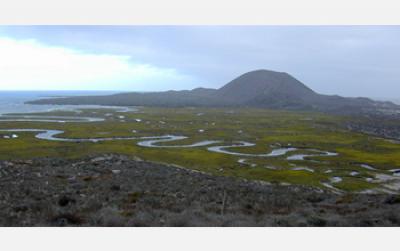
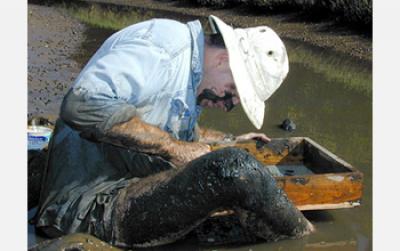
In a study of parasites living in three estuaries on the Pacific coast of California and Baja California, researchers have determined that biomass of these parasites exceeds that of top predators, in some cases by more than 20 times. Their findings, which could have significant ecological and biomedical implications, appear in this week's issue of the journal Nature.
Biomass is the amount of living matter that exists in a given habitat. It is expressed either as the weight of organisms per unit area or as the volume of organisms per unit volume of habitat.
Until now, scientists have believed that because parasites are microscopic in size they comprised a small fraction of biomass in a habitat, while free-living organisms such as fish, birds and other predators make up the vast majority.
"We quantified the biomass of free-living and parasitic species in three estuaries and discovered that parasites have substantial biomass in these ecosystems," said Armand Kuris, a zoologist at the University of California at Santa Barbara (UCSB), and a lead author of the paper.
"Parasites have as much, or even more, biomass than other important groups of animals--like birds, fish and crabs," said Ryan Hechinger, a marine scientist at UCSB and co-lead author of the paper.
The results are part of a study supported the National Science Foundation (NSF) and the National Institutes of Health through the agencies' joint Ecology of Infectious Diseases (EID) Program.
"Unlike large animals, such as birds, parasites are tiny and often easy to overlook," said Sam Scheiner, NSF program director for EID, co-funded by NSF's Directorates for Biological Sciences and Geosciences. "These results will cause ecologists and other scientists to completely reconsider their views."
Other principal investigators include Kevin Lafferty, a marine ecologist with the United States Geological Survey and Andrew Dobson, an ecologist and evolutionary biologist at Princeton University, as well as Leopoldina Aguirre-Macedo, of the Centro de Investigación y Estudios Avanzados Unidad Mérida, and Mark Torchin, with the Smithsonian Tropical Research Institute.
The researchers quantified parasites and free-living organisms in the Carpinteria Salt Marsh in California, and in the Bahia San Quintín and Estero de Punta Banda estuaries in Baja California. Their study included 199 species of free-living animals, 15 species of free-living vascular plants, and 138 species of parasites.
"A lot of work we've done has suggested that parasites are important in ecosystems," said Lafferty. "But no one's actually looked at them as a group throughout an ecosystem."
"Also, no one's considered parasites from the perspective of how much they weigh, because it's always been assumed they weigh almost nothing," he said. "Now we know that's not true."
For example, in an estuary there are more kilograms of trematode worms--parasites--than kilograms of birds, the scientists found.
The study's results have a potential impact on the perceived role of parasites in the ecosystem. From an ecological perspective, parasites serve both as regulators to prevent species from becoming numerically dominant, and as indicators of the health of a particular ecosystem.
"No one debates whether it's important for ensuring human welfare to understand how ecosystems work," said Hechinger. "How can we understand something without accounting for its major parts?"
According to Kuris, understanding the enormity of parasite biomass and the burden it places on available hosts could lead to new strategies in the management of infectious diseases.
Treatment protocols might put greater emphasis on enhancing the host's ability to defend itself against parasitic disease and slow the rate of energy uptake by the parasites and pathogens.
"The total amount of energy flow in ecosystems due to infectious processes must be enormous--even greater than we'd expect given the large parasite biomass," Kuris said. "The amount of energy going into host tissue repair and replenishment is also huge."
Source: National Science Foundation
Articles on the same topic
- Study shows parasites outweigh predatorsWed, 23 Jul 2008, 18:28:29 UTC
Other sources
- Parasites Vastly Outweigh Predators In Estuaries: Could Have Significant Ecological Implicationsfrom Science DailyThu, 24 Jul 2008, 2:21:17 UTC
- Parasites powerful influence, study findsfrom UPIWed, 23 Jul 2008, 21:42:21 UTC
- Study shows parasites outweigh predatorsfrom PhysorgWed, 23 Jul 2008, 18:28:07 UTC