


Strawberry extract protects against UVA rays
Related images
(click to enlarge)
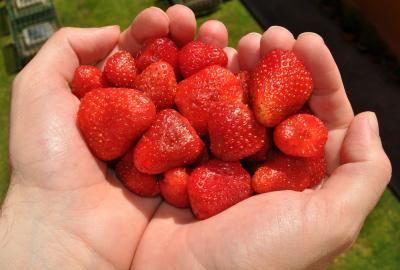
An experiment has shown that strawberry extract added to skin cell cultures acts as a protector against ultraviolet radiation as well as increasing its viability and reducing damage to DNA. Developed by a team of Italian and Spanish researchers, the study opens the door to the creation of photoprotective cream made from strawberries. "We have verified the protecting effect of strawberry extract against damage to skins cells caused by UVA rays," as explained by Maurizio Battino, researcher at the Università Politecnica delle Marche in Italy and lead author of the jointly Spanish and Italian study. The results are published in the 'Journal of Agricultural Food Chemistry'.
The team prepared human skin cell cultures (fibroblasts) and added strawberry extract in different concentrations (0.05, 0.25 and 0.5 mg/ml), the only exception being the control extract. Using ultraviolet light, the samples were then exposed to a dose "equivalent to 90 minutes of midday summer sun in the French Riviera."
Data confirm that the strawberry extract, especially at a concentration of 0.5 mg/ml, displays photoprotective properties in those fibroblasts exposed to UVA radiation, it increases cell survival and viability and decreases damage in the DNA when compared with control cells.
"These aspects are of great importance as they provide protection for cell lines subject to conditions that can provoke cancer and other skin-related inflammatory and degenerative illnesses," outlines Battino.
The researcher recognises that this is the "first step in determining the beneficial effects of strawberries in our diet or as a possible compound source for 'food integrators' or cosmetics for instance."
The redness of anthocyanins
But what molecules give strawberries their photoprotective properties? Scientists suspect that it could be the anthocyanins, which are pigments that give leaves, flowers and fruits their red colour. Analyses have confirmed that extracts are rich in such substances.
"These compounds have important anti-inflammatory, antioxidant and anti-tumour properties and are capable of modulating enzymatic processes," explains another of the authors, Sara Tulipani from the University of Barcelona. She adds that "we have not yet found a direct relationship between their presence and photoprotective properties."
"At the moment the results act as the basis for future studies evaluating the 'bioavailability' and 'bioactivity' of anthocyanins in the dermis and epidermis layers of the human skin, whether by adding them to formulations for external use or by ingesting the fruit itself," states Tulipani.
Also made up of researchers from the Universities of Salamanca and Granada, in its previous works the team had already demonstrated that strawberries (Fragaria x ananassa) strengthen the red bloods cells and protect the stomach from the effects of alcohol.
Source: Plataforma SINC
Other sources
- Strawberry extract protects against UVA raysfrom PhysorgFri, 3 Aug 2012, 14:31:06 UTC
- Strawberry extract protects against UVA rays, study suggestsfrom Science DailyFri, 3 Aug 2012, 14:30:31 UTC