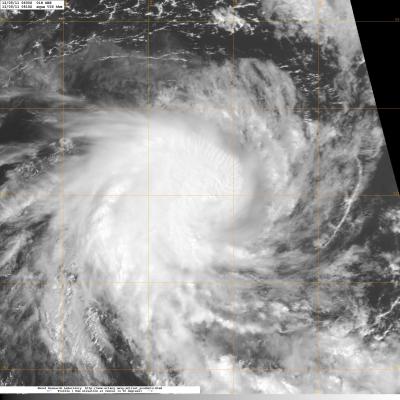
NASA sees birth of first Southern Indian Ocean season tropical storm
The Southern Indian Ocean cyclone season is off and running and NASA's Aqua satellite saw the birth of Tropical Cyclone 01S. Tropical Cyclone 01S (TC01S) formed Dec. 5, 2011. TC01S has maximum sustained winds near 55 knots (63 mph/102 kmh) and is rapidly consolidating and organizing, so strengthening is forecast. At 0900 UTC (4 a.m. EST) on Dec. 5, TC01S was located about 545 nautical miles west of the Cocos Islands near 12.2 South and 87.0 East. It was moving to the west at 7 knots 8 mph/13 kmh).
The Moderate Resolution Imaging Spectroradiometer (MODIS) instrument on NASA's Aqua satellite captured an image of Tropical Cyclone 01S on Dec. 5 at 08:18 UTC (3:18 a.m. EST) in the Southern Indian Ocean. Strong thunderstorms are visible around the center as they cast shadows on the lower surrounding clouds.
Microwave satellite instruments showed an eye developing in TC01S. There is also tightly curved banding of thunderstorms around the low-level center. T01S has intensified rapidly over the first 12 hours of its existence. The Joint Typhoon Warning Center forecasters expect TC01S to strengthen to hurricane-force over the next two days and track to the southeast, staying at sea.
Source: NASA/Goddard Space Flight Center
Related
- NASA's Terra satellite spots Tropical Cyclone Anja, the first of the southern seasonMon, 16 Nov 2009, 16:15:21 EST
- NASA's Aqua Satellite sees a tight Tropical Storm 21STue, 23 Mar 2010, 14:32:28 EDT
- NASA's Aqua satellite sees second tropical storm form near the Horn of AfricaWed, 19 May 2010, 15:19:43 EDT
- NASA satellite attends the birth of Tropical Storm Bune in Southern PacificThu, 24 Mar 2011, 17:33:14 EDT
- NASA's QuikScat and Aqua providing important data on Tropical Storm AnjaWed, 18 Nov 2009, 10:36:08 EST
Other sources
- NASA sees Alenga become a cyclone in the Southern Indian Oceanfrom PhysorgThu, 8 Dec 2011, 17:00:40 EST
- NASA sees Tropical Storm Alenga intensifyingfrom PhysorgWed, 7 Dec 2011, 16:31:08 EST
- NASA's TRMM satellite sees the power in Tropical Storm Alengafrom Science DailyWed, 7 Dec 2011, 1:40:30 EST
- NASA's TRMM satellite sees the power in Tropical Storm Alengafrom PhysorgTue, 6 Dec 2011, 17:31:03 EST
- NASA sees birth of first Southern Indian Ocean season tropical stormfrom Science DailyMon, 5 Dec 2011, 19:50:54 EST
- NASA sees birth of first Southern Indian Ocean season tropical stormfrom PhysorgMon, 5 Dec 2011, 17:21:43 EST
Latest Science Newsletter
Get the latest and most popular science news articles of the week in your Inbox! It's free!Learn more about
Check out our next project, Biology.Net
Popular science news articles
- Good news for nanomedicine: Quantum dots appear safe in pioneering study on primates
- Taking solar technology up a notch
- El Niño weather and climate change threaten survival of baby leatherback sea turtles
- Using graphene, scientists develop a less toxic way to rust-proof steel
- Deep sea animals stowaway on submarines and reach new territory
- Good news for nanomedicine: Quantum dots appear safe in pioneering study on primates
- Pacific islands may become refuge for corals in a warming climate, study finds
- In metallic glasses, researchers find a few new atomic structures
- New graphene-based material could revolutionize electronics industry
- UCLA researchers map damaged connections in Phineas Gage's brain
- Modern dog breeds genetically disconnected from ancient ancestors
- Calcium supplements linked to significantly increased heart attack risk
- Good news for nanomedicine: Quantum dots appear safe in pioneering study on primates
- New study examines relationship between social status and wound healing in wild baboons
- New silicon memory chip developed
- Italian merchants funded England's discovery of North America
- New graphene-based material could revolutionize electronics industry
- Babies' brains benefit from music lessons, researchers find
- Happiness model developed by MU researcher could help people go from good to great
- UCLA researchers map damaged connections in Phineas Gage's brain