


Changing Chesapeake Bay acidity impacting oyster shell growth
Related images
(click to enlarge)
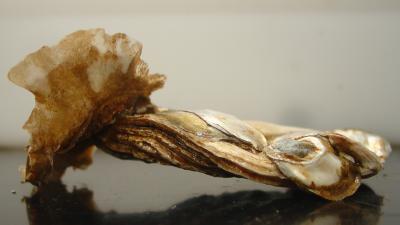
Acidity is increasing in some regions of the Chesapeake Bay even faster than is occurring in the open ocean, where it is now recognized that increased levels of atmospheric carbon dioxide dissolve in the seawater thereby making it more acidic. These more acidic conditions in key parts of Chesapeake Bay reduce rates of juvenile oyster shell formation, according to new research published in the journal Estuaries and Coasts. The study, conducted at the University of Maryland Center for Environmental Science, examined 23 years of water quality data and concluded that significant trends in acidity will have mixed impacts on juvenile oyster growth, with some areas becoming more acidic and others more alkaline. "The regional changes in acidity revealed in our analysis are greater than what could be caused by increasing atmospheric carbon dioxide alone," said lead author Dr. George Waldbusser of Oregon State University. "We are seeing a complex pattern of increasing acidity in the more saline regions of the Bay, but the opposite trend of decreasing acidity in the less saline waters of the Bay."
"Current average pH values in intermediate salinity waters of the Chesapeake Bay were found in our laboratory studies to decrease rates of shell formation leading to thinner shells of our native oyster," said marine biologist Dr. Roger Newell of the UMCES Horn Point Laboratory. "With oyster populations already at historically low levels, increasingly acidic waters are yet another stressor limiting the recovery of the Bay's oyster populations." In other recent research Newell and colleagues have shown that thinner shells render juvenile oysters increasingly vulnerable to crab predation.
Ms. Erin Voigt, who worked on this project in Dr. Waldbusser's lab at the Chesapeake Biological Laboratory for her senior undergraduate thesis research at St. Mary's College of Maryland noted, "The complex response of oyster shell formation to temperature, salinity, and acidity highlights the need to understand how the entire ecosystem is changing, not just acidity."
The scientists attribute the observed spatial variation in acidity to changes in the base of the food web in the upper Chesapeake Bay. Inputs of nutrients from sewage systems and agriculture promote increased phytoplankton populations in the upper Bay. As these plants grow they absorb large amounts of carbon dioxide from the water column, thereby making waters in that region less acidic. As these phytoplankton are carried toward the ocean by the Bay's currents, they are consumed by animals and bacteria. The respiration of this phytoplankton organic material results in the release of the same carbon dioxide taken up by the phytoplankton, which remains dissolved in the water making it significantly more acidic.
"Carbon dioxide is a weak acid and whether it is produced by fossil fuel combustion or enhanced phytoplankton growth and decay, the resulting acidic conditions have the same negative effect on shell forming animals, such as oysters and corals," notes Dr. Waldbusser.
"Decreasing acidity in the low salinity waters and increasing acidity in the higher salinity waters of the Bay highlights natural variations that have not typically been considered with respect to increasing atmospheric carbon dioxide in the Chesapeake Bay ecosystem" added Waldbusser. "While these variations in acidity may improve conditions for shellfish in some areas, they may also magnify detrimental impacts in others. What our study indicates is there may be an important shifting baseline and without better measurements we will fail to fully understand impacts on estuarine biota."
However, Dr. Waldbusser cautioned that the long term baseline trends they found in archived Bay Program data sets are just the first step towards understanding acidity changes in Chesapeake Bay due to limitations of traditional pH measurements in estuarine waters and daytime sampling bias.
"Our analysis highlights the need to develop better monitoring and measurement protocols of the carbonate system in highly variable estuarine waters, especially in light of the sensitivity of oyster shell growth to changes in pH, salinity, and temperature."
Source: University of Maryland Center for Environmental Science
Other sources
- Changing Chesapeake Bay acidity impacting oyster shell growthfrom PhysorgThu, 10 Jun 2010, 19:14:33 UTC
- Chesapeake Bay becoming more acidic, impacting oyster shell growthfrom Science DailyThu, 10 Jun 2010, 16:13:08 UTC