


Grocery shoppers who try harder to track costs do worse, study finds
Related images
(click to enlarge)
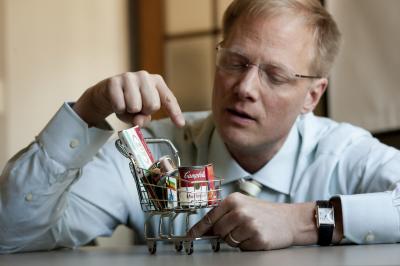
Almost one in three U.S. households shop on a budget — and one in six can only afford basic necessities. So it's no wonder that 78 percent of budget shoppers — twice as many as those who shop without a budget (37 percent) — try to track how much their groceries are likely to cost as they roll through the aisles. But the harder they try, the worse they do — overspending by as much as 19 percent, according to a new study, which was conducted by a Cornell professor and colleagues and is published in this month's Journal of Marketing.
In general, the researchers found that all consumers tend to underestimate how much their groceries are going to cost.
"But those who try to calculate the exact total price almost always do worse than those who just estimate approximate prices," said Brian Wansink, Cornell's John S. Dyson Professor of Marketing, who co-authored the series of studies with Koert van Ittersum of the Georgia Institute of Technology and Joost M.E. Pennings of Maastricht University, the Netherlands. Their work included two field studies and two laboratory studies.
It is low-income shoppers who try most to calculate, rather than estimate, Wansink said.
That means that those on the tightest budgets — those most motivated to track their spending — may be at greatest risk for spending more than their budget allows, said Wansink, forcing them to cut back in other areas, which "could cause shoppers unexpected financial distress." This chain of events can also cause these shoppers to develop negative feelings toward the store they patronize because they spent more than they planned.
The researchers also found that the most accurate shoppers based their estimates on the dominant range of price endings in their baskets — such as the 99 cents in $4.99. In other words, if the price endings of most of the grocers are between $.50 and $.99, people rounded up to the nearest dollar. "When people don't round up, it leads to some unpleasant surprises at the cash register," said van Ittersum.
Wansink suggests that the retailers might help consumers estimate the cost of their groceries with cart scanners, by changing their price-setting strategies or by providing shopper trainings in the principles of decision making, statistics, and mental computation.
In the meantime, the researchers offer these tips:
- Round each item to the nearest dollar — $2.25 becomes $2 and $5.50 becomes $6.
- If you lose track, estimate the total number of items, then guess the price of the average item and multiply them together.
- If you really want to calculate the exact total price, use a calculator.
Source: Cornell Food & Brand Lab
Other sources
- Grocery shoppers who try harder to track costs do worse, study findsfrom PhysorgWed, 31 Mar 2010, 4:14:08 UTC
- Grocery shoppers who try harder to track costs do worse, study findsfrom Science BlogTue, 30 Mar 2010, 22:35:24 UTC