


Caltech neuroscientists find brain system behind general intelligence
Related images
(click to enlarge)
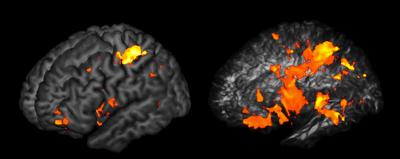
A collaborative team of neuroscientists at the California Institute of Technology (Caltech), the University of Iowa, the University of Southern California (USC), and the Autonomous University of Madrid have mapped the brain structures that affect general intelligence. The study, to be published the week of February 22 in the early edition of the Proceedings of the National Academy of Sciences, adds new insight to a highly controversial question: What is intelligence, and how can we measure it?
The research team included Jan Gläscher, first author on the paper and a postdoctoral fellow at Caltech, and Ralph Adolphs, the Bren Professor of Psychology and Neuroscience and professor of biology. The Caltech scientists teamed up with researchers at the University of Iowa and USC to examine a uniquely large data set of 241 brain-lesion patients who all had taken IQ tests. The researchers mapped the location of each patient's lesion in their brains, and correlated that with each patient's IQ score to produce a map of the brain regions that influence intelligence.
"General intelligence, often referred to as Spearman's g-factor, has been a highly contentious concept," says Adolphs. "But the basic idea underlying it is undisputed: on average, people's scores across many different kinds of tests are correlated. Some people just get generally high scores, whereas others get generally low scores. So it is an obvious next question to ask whether such a general ability might depend on specific brain regions."
The researchers found that, rather than residing in a single structure, general intelligence is determined by a network of regions across both sides of the brain.
"One of the main findings that really struck us was that there was a distributed system here. Several brain regions, and the connections between them, were what was most important to general intelligence," explains Gläscher.
"It might have turned out that general intelligence doesn't depend on specific brain areas at all, and just has to do with how the whole brain functions," adds Adolphs. "But that's not what we found. In fact, the particular regions and connections we found are quite in line with an existing theory about intelligence called the 'parieto-frontal integration theory.' It says that general intelligence depends on the brain's ability to integrate—to pull together—several different kinds of processing, such as working memory."
The researchers say the findings will open the door to further investigations about how the brain, intelligence, and environment all interact.
Source: California Institute of Technology
Other sources
- Brain system behind general intelligence discoveredfrom Science DailyTue, 23 Feb 2010, 4:28:07 UTC
- Neuroscientists find brain system behind general intelligencefrom PhysorgMon, 22 Feb 2010, 20:07:39 UTC