


Conflict between plant and animal hormones in the insect gut?
Related images
(click to enlarge)
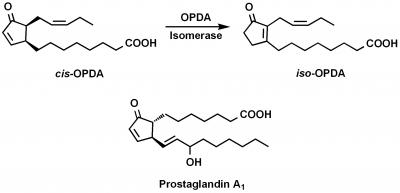
This press release is available in German. Cis-OPDA (12-oxophytodienoic acid) is a highly reactive plant hormone which simultaneously serves as a precursor molecule of the metabolic "master switch" jasmonic acid. Both signal herbivory in leaves and shoots of plants and activate the plants' defense reaction against caterpillars. Cis-OPDA, when reaching the hemolymph of the caterpillar, has a negative effect on the animal, leading to premature pupation and, apparently, an impaired immune system.
Paulina Dabrowska, one of the very first PhD students of the Jena International Max Planck Research School (IMPRS) who meanwhile earned her PhD, studied the whereabouts of plant hormones after they had been consumed by the caterpillars and had passed the insect gut. Are the hormones, which are known to severely influence development and metabolism of organisms even in the slightest dose, fully metabolized in the insect gut, just converted, or not influenced at all?
Studying the plant hormone cis-OPDA it became quickly evident that a conversion of the molecule must have taken place in the insect gut. The young chemist, originally from Poland, discovered that an enzyme must play a role in the chemical reaction observed: "First, we found that cis-OPDA was not present in the insect feces anymore. Instead of cis-OPDA, our mass spectrometers suggested iso-OPDA. However, iso-OPDA is only constituted by means of enzyme catalysis." Control experiments, solely performed in strong alkaline solutions as present in the insect gut (pH approx. 10), did not cause a cis-iso conversion. The test animals were Spodoptera littoralis (cotton leaf worm) and Helicoverpa armigera (cotton bollworm) larvae; both species are major cotton pests worldwide.
When isomerizing cis-OPDA to iso-OPDA, only one double bond in the molecule is relocated, drastically changing its spatial structure: An angulate molecule with a reactive double bond (cis-OPDA) becomes a planar molecule whose double bond can only react under forced conditions. A quite similar reaction has been previously described for prostaglandins, to be exact, the transformation of active prostaglandin A1 into inactive prostaglandin B1. OPDA and prostaglandins have a similar molecule structure and biosynthesis. Isomerization of these substances can be catalyzed by specific enzymes that, for instance, use glutathione as a substrate. Therefore, Paulina Dabrowska and Dalial Freitak, another former IMPRS student, looked for corresponding genes in the genome of Helicoverpa armigera that encode such enzymes and found 16 different glutathione S-transferases (GSTs) in the insect gut. Only one of the enzymes catalyzes the cis-iso conversion of OPDA. "This clearly demonstrates that of the 16 GSTs the cotton bollworm needs for many different metabolic pathways, this specific GST represents the evolutionary adaptation to its host plants," says Prof. Wilhelm Boland, in whose Department of Bioorganic Chemistry the studies have been carried out in cooperation with the Department of Entomology of Prof. David Heckel. The host spectrum of this insect pest is not limited to cotton, but includes many other plant species as well. The ability to inactivate cis-OPDA is especially found in host generalists (caterpillars with a broad food spectrum), but hardly ever in specialist insects.
Source: Max Planck Institute for Chemical Ecology
Other sources
- Plants Choose Ammunition Carefullyfrom Science DailySat, 19 Sep 2009, 5:29:16 UTC
- Conflict Between Plant And Animal Hormones In The Insect Gut?from Science DailyFri, 18 Sep 2009, 1:28:42 UTC
- Conflict between plant and animal hormones in the insect gut?from PhysorgMon, 14 Sep 2009, 20:42:47 UTC