


Particles as tracers for the most massive explosions in the Milky Way
Related images
(click to enlarge)
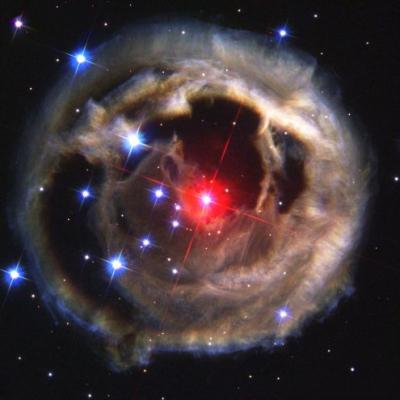

Astronomers recently observed a mysterious flux of particles in the universe, and the hope was born that this may be the first observation of the remnants of "dark matter". But scientists from the University of Gothenburg, Sweden, have shown that there is another explanation of the flux.
Several independent studies recently discovered a mysterious flux of electrons and positrons in the universe. Several theories were presented that suggested that these particles arise from the decay of "dark matter" - the hypothetical material that is believed to influence the rotation of galaxies. Dark matter is one of the most challenging questions in astrophysics. An international research group with members from the University of Gothenburg has now published new results showing that the mysterious flux actually arises from exploding stars.
Supernova remnants
Julia Becker, from the Department of Physics at the University of Gothenburg, and her colleagues show in the article, which has been published in the scientific journal Physical Review Letters, that the mysterious particle flux is the remnant of a supernova, from a star that was 15 times more massive than the sun. This star died and exploded in the Milky Way. When a star of this mass dies, most of its material is ejected and ploughs a pathway through a massive, stellar wind. This wind has been created earlier in the death process, when the star lost part of its original mass. The wind blows away from the star, and the final definitive explosion of the star then drives new material through the previously established wind.
A shock-wave in space
Electrons and positrons are accelerated during the process and create a shock-wave, similar to that formed when an aeroplane breaks the sound barrier. Julia Becker and her colleagues show that it is just such a shock-wave that has created the observed particle flux that has astounded scientists. "This means, I'm afraid, that scientists will have to find another method of identifying dark matter", says Julia Becker.
Source: University of Gothenburg
Other sources
- Particles as tracers for the most massive explosions in the Milky Wayfrom PhysorgTue, 11 Aug 2009, 17:14:42 UTC
- Particles as tracers for the most massive explosions in the Milky Wayfrom Science BlogTue, 11 Aug 2009, 15:42:38 UTC