


HIPS fireproof coatings can really take the heat
Related images
(click to enlarge)
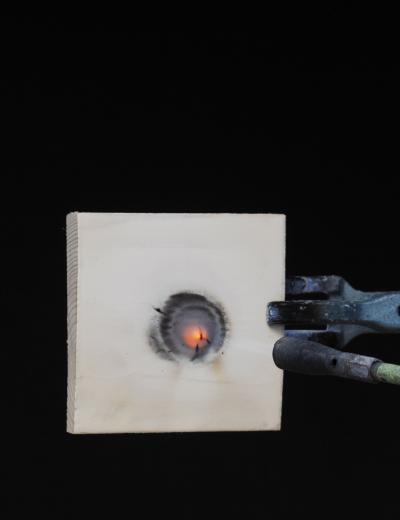
Tough new fire-resistant coating materials called HIPS ('hybrid inorganic polymer system') are being developed by CSIRO researchers in Melbourne. HIPS coatings can withstand temperatures of over 1000°C compared to current commercial coatings used on building materials and structures which break down at between 150-250°C.
HIPS coatings contain an inorganic geopolymer resin, and a small component of polymer additives.
Project leader, Dr Damian Fullston of CSIRO Materials Science and Engineering, says CSIRO is seeking coatings manufacturers interested in partnering with CSIRO to customise HIPS to meet product specifications for selected applications.
"Geopolymers are an emerging class of ceramic-like inorganic polymers produced at room temperatures that have the potential to transform the building products industry," Dr Fullston says. "They are not only fire-, blast- and acid-resistant, they are also strong, castable, sprayable, and extrudable, making their potential uses almost limitless."
"The polymer additives in HIPS improve the flexibility and waterproofing properties, and provide stronger adhesion, which are important properties for a coating."
HIPS has the potential to form thin fireproof coatings on timbers such as weatherboards, and on metals such as structural or galvanised steel. It can also protect brickwork, either as a thin coating or as a render. HIPS can be applied by spray equipment, roller or brush, and cures from ambient temperature to below 90°C.
As water-based products, HIPS coatings are free of volatile organic compounds, do not burn or produce heat, and do not release smoke or toxic chemicals at temperatures up to 1200°C.
Geopolymers are cost-competitive, since they are made from readily available raw materials. They can also be derived from industrial by-products such as flyash and blast furnace slag. They can be cheaper than organic resins and coloured with pigments or dyes.
The strength of HIPS materials is comparable with that of phenolic resins in heat-sensitive applications, but HIPS retains higher strength at higher temperatures. HIPS formulations are tailored to be interchangeable with phenolic resins, and have higher fatigue resistance than normal phenolics. CSIRO also sees potential for the manufacture of fireproof wood composites and fire seals from HIPS technology, but has not fully explored these applications to date.
Source: CSIRO Australia
Other sources
- New Fireproof Coatings Can Really Take The Heatfrom Science DailyMon, 20 Jul 2009, 15:28:36 UTC
- HIPS fireproof coatings can really take the heatfrom PhysorgMon, 20 Jul 2009, 15:07:12 UTC