


Surprise: Typhoons trigger slow earthquakes
Related images
(click to enlarge)
Scientists have made the surprising finding that typhoons trigger slow earthquakes, at least in eastern Taiwan. Slow earthquakes are non-violent fault slippage events that take hours or days instead of a few brutal seconds to minutes to release their potent energy. The researchers discuss their data in a study published the June 11, issue of Nature.
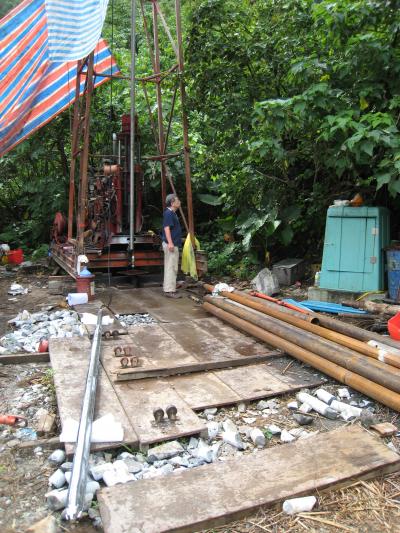
"From 2002 to 2007 we monitored deformation in eastern Taiwan using three highly sensitive borehole strainmeters installed 650 to 870 feet (200-270 meters) deep. These devices detect otherwise imperceptible movements and distortions of rock," explained coauthor Selwyn Sacks of Carnegie's Department of Terrestrial Magnetism. "We also measured atmospheric pressure changes, because they usually produce proportional changes in strain, which we can then remove."
Taiwan has frequent typhoons in the second half of each year but is typhoon free during the first 4 months. During the five-year study period, the researchers, including lead author Chiching Liu (Academia Sinica, Taiwan), identified 20 slow earthquakes that each lasted from hours to more than a day. The scientists did not detect any slow events during the typhoon-free season. Eleven of the 20 slow earthquakes coincided with typhoons. Those 11 were also stronger and characterized by more complex waveforms than the other slow events.
"These data are unequivocal in identifying typhoons as triggers of these slow quakes. The probability that they coincide by chance is vanishingly small," remarked coauthor Alan Linde, also of Carnegie.
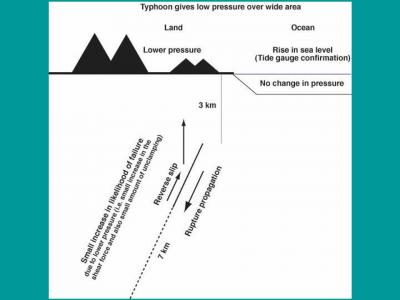
How does the low pressure trigger the slow quakes? The typhoon reduces atmospheric pressure on land in this region, but does not affect conditions at the ocean bottom, because water moves into the area and equalizes pressure. The reduction in pressure above one side of an obliquely dipping fault tends to unclamp it. "This fault experiences more or less constant strain and stress buildup," said Linde. "If it's close to failure, the small perturbation due to the low pressure of the typhoon can push it over the failure limit; if there is no typhoon, stress will continue to accumulate until it fails without the need for a trigger."
"It's surprising that this area of the globe has had no great earthquakes and relatively few large earthquakes," Linde remarked. "By comparison, the Nankai Trough in southwestern Japan, has a plate convergence rate about 4 centimeters per year, and this causes a magnitude 8 earthquake every 100 to 150 years. But the activity in southern Taiwan comes from the convergence of same two plates, and there the Philippine Sea Plate pushes against the Eurasian Plate at a rate twice that for Nankai."
The researchers speculate that the reason devastating earthquakes are rare in eastern Taiwan is because the slow quakes act as valves, releasing the stress frequently along a small section of the fault, eliminating the situation where a long segment sustains continuous high stresses until it ruptures in a single great earthquake. The group is now expanding their instrumentation and monitoring for this research.
Source: Carnegie Institution
Other sources
- Typhoons trigger slow earthquakesfrom BBC News: Science & NatureThu, 11 Jun 2009, 8:14:07 UTC
- Raging Typhoons May Soothe Quakesfrom Science NOWWed, 10 Jun 2009, 21:56:09 UTC
- Typhoons Can Trigger Earthquakes, Study Suggestsfrom National GeographicWed, 10 Jun 2009, 21:28:14 UTC
- Typhoons Trigger Slow Earthquakesfrom Science DailyWed, 10 Jun 2009, 18:28:16 UTC
- Typhoons trigger earthquakes on Taiwan: scientistsfrom PhysorgWed, 10 Jun 2009, 17:42:38 UTC