


New research study reveals origin of volcano's carbon-based lavas
Related images
(click to enlarge)
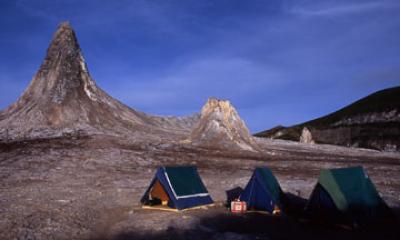
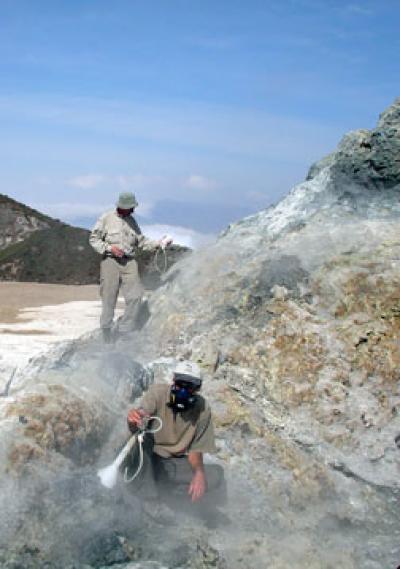
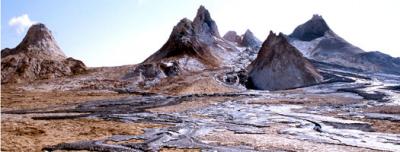
Scientists studying the world's most unusual volcano have discovered the reason behind its unique carbon-based lavas. The new geochemical analyses reveals that an extremely small degree of partial melting of typical minerals in the earth's upper mantle is the source of the rare carbon-derived lava erupting from Tanzania's Oldoinyo Lengai volcano. Although carbon-based lavas, known as carbonatites, are found throughout history, the Oldoinyo Lengai volcano, located in the East African Rift in northern Tanzania, is the only place on Earth where they are actively erupting. The lava expelled from the volcano is highly unusual in that it contains almost no silica and greater than 50 percent carbonate minerals. Typically lavas contain high levels of silica, which increases their melting point to above 900°C (1652°F). The lavas of Oldoinyo Lengai volcano erupt as a liquid at approximately 540°C (1004°F). This low silica content gives rise to the extremely fluid lavas, which resembles motor oil when they flow.
A team of scientists from University of New Mexico, Scripps Institution of Oceanography at UC San Diego and Centre de Recherches Petrographiques et Geochimiques in Nancy, France, report new findings of volcanic gas emissions in a paper published in the May 7 issue of the journal Nature.
"The chemistry and isotopic composition of the gases reveal that the CO2 is directly sourced from the upper mantle below the East African Rift," said David Hilton, professor of geochemistry at Scripps Institution of Oceanography at UC San Diego and coauthor of the paper. "These mantle gases allow us to infer the carbon content of the upper mantle that is producing the carbonatites to be around 300 parts per million, a concentration that is virtually identical to that measured below mid-ocean ridges."
Mid-ocean ridges are underwater mountain ranges where the seafloor is spreading due to tectonic plates moving away from one another. Rift valleys, such as the one where Oldoinyo Lengai volcano is located, and mid-ocean ridges are considered to be distinct tectonic regions. However, this study has shown that their chemistries are identical, which led the scientists to suggest that the carbon contents of their mantle sources were not different but due to partial melting of typical minerals located in the earth's mantle.
"Since the volcano was under magma pressure during the eruption, we were able to collect pristine samples of the volcanic gases, with minimal air contamination," said Tobias Fischer, volcanologist at the University of New Mexico. The pristine samples collected during a 2005 eruption offered the scientists a deeper look at the processes taking place in the earth's upper mantle.
The geochemical analyses, some of which were conducted at Hilton's geochemical lab at Scripps Oceanography, revealed that magma from the upper mantle below both the oceans and continents is a uniform and well-mixed reservoir of "typical" volcanic gases such as carbon dioxide, nitrogen, argon and helium.
The lava expelled from the volcano is highly unusual in that it contains almost no silica and greater than 50 percent carbonate minerals. Typically lavas contain high levels of silica, which increases their melting point to above 900°C (1652°F). The lavas of Oldoinyo Lengai volcano are comprised of carbonatites, which erupts as a liquid at approximately 540°C (1004°F). This low silica content gives rise to the extremely fluid lavas, which resembles motor oil when they flow.
"These finding are significant because it shows that these extremely bizarre lavas and their parent magmas, nephelinites, were produced by melting of a typical upper mantle mineral assemblage without an extreme carbon content in the magma source," said geochemist Bernard Marty at the Centre de Recherches Petrographiques et Geochimiques in Nancy, France. "Rather, in order to make carbonatite lavas, all you need is a very low melt fraction of 0.3 percent or less."
Oldoinyo Lengai, like all volcanoes, emits carbon dioxide into the atmosphere as a gas. However, Lengai's magma is unusual in that it also contains high sodium contents. About one percent of the mantle-derived carbon emitted from Lengai goes into the carbonatite melt with the remainder being emitted into the atmosphere as CO2 gas. The CO2 released into the atmosphere by volcanoes worldwide is a small fraction when compared to man-made emissions.
Source: University of California - San Diego
Articles on the same topic
- Alchemy in Tanzania? Gas becomes solid at surface of Oldoinyo Lengai volcanoFri, 8 May 2009, 14:22:35 UTC
Other sources
- World's Most Unusual Volcano: Origin Of Carbon-based Lavas Revealedfrom Science DailyThu, 7 May 2009, 14:28:22 UTC
- Determining processes at work in Earth's upper mantlefrom PhysorgWed, 6 May 2009, 17:28:35 UTC