


'Natural' nitrogen-fixing bacteria protect soybeans from aphids
Related images
(click to enlarge)
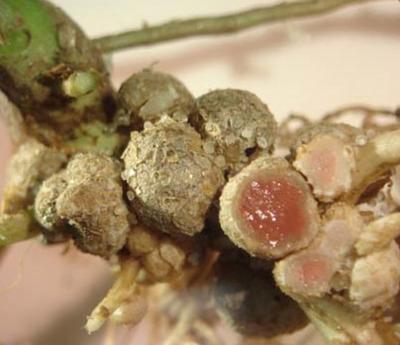
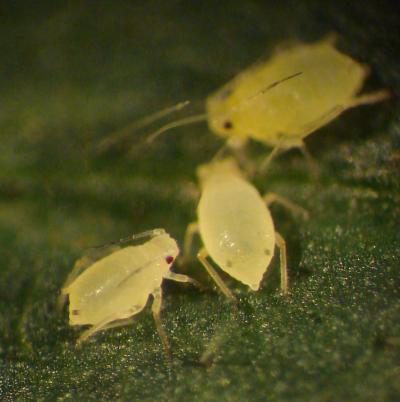
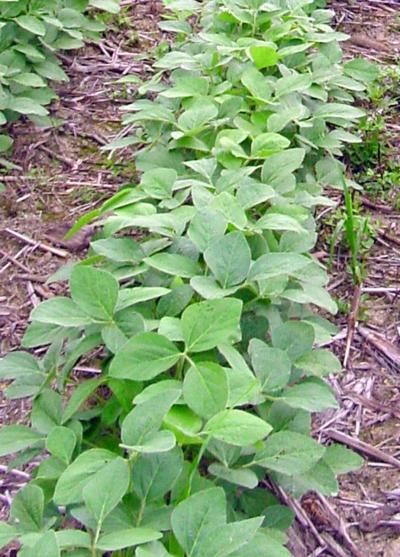
An invasion of soybean aphids poses a problem for soybean farmers requiring application of pesticides, but a team of Penn State entomologists thinks a careful choice of nitrogen-fixing bacteria may provide protection against the sucking insects. Soybeans are legumes, plants that can have a symbiotic relationship with nitrogen-fixing bacteria -- rhizobia -- and therefore do not need additional nitrogen fertilizer. Each type of legume -- peas, beans, lentils, alfalfa -- have their own rhizobia.
"Soybeans are from Asia and so there were originally no nitrogen-fixing bacteria that would colonize soybeans in U.S. soils," said Consuelo De Moraes, associate professor of entomology. "The rhizobia had to be transferred here."
The soybean aphid is also not native to North America. This pest only began to infest soybean fields about 10 years ago but are now fully established pests requiring pesticide applications to avoid the loss of as much as 40 percent of the crop. The researchers investigated the relationship between the type of rhizobia colonizing soybean plants and the plants' infestation with the aphids.
"Our results demonstrate that plant–rhizobia interactions influence plant resistance to insect herbivores and that some rhizobia strains confer greater resistance to their mutualist partners than do others," the researchers report in the journal Plant and Soil online.
They looked at soybean plants inoculated with the rhizobia provided by the inoculant company; without rhizobia, but with added nitrogen fertilizer, and by existing rhizobia in the soil.
"The bacteria that were used initially to inoculate the first crops of soybeans are growing wild in the soil now," said Mark C. Mescher. "They are now considered "naturally occurring" and are different from the inoculants purchased with the soybean seeds."
They become natural because they change through generations of contact with other rhizobia. While they may not provide as much nitrogen to the plant as commercial types, the trade off between optimal growth and heavy insect damage may still be worthwhile.
"In most cases, the inoculant companies provide rhizobia for inoculation that gives plants the maximum yield," said Jennifer M. Dean, postdoctoral fellow in entomology. "Their rhizobia are highly competitive against naturally occurring nitrogen-fixing bacteria. The inoculant companies treat the natural rhizobia almost as a pest."
Because of this, soybeans almost uniformly incorporate the specially developed rhizobia rather than the natural ones. However, the researchers found that the plants associated with the naturally occurring rhizobia had lower aphid densities than either the artificially fertilized plants or the plants inoculated with commercial rhizobia. They also found the same level of nitrogen in both soybean plants inoculated with natural rhizobia and those inoculated with commercial varieties.
"This is the first time anyone has shown how different strains of rhizobia can effect herbivory," said De Moraes. "This may be another tool to use to protect plants from insect herbivory. It may also be applicable to other legumes."
The researchers do not yet know what the natural nitrogen-fixing bacteria do to repel aphids.
"It is really exciting to see that the nitrogen producing rhizobia can be protective," said Dean. "Next we want to isolate rhizobia strains from the fields and look for the specific mechanism of how they repel the aphids."
Source: Penn State
Other sources
- 'Natural' nitrogen-fixing bacteria protect soybeans from aphidsfrom PhysorgTue, 14 Apr 2009, 15:42:42 UTC
- Bacteria protect soybeans from aphidsfrom UPITue, 14 Apr 2009, 15:42:22 UTC