


University of Kansas graduate student researcher takes aim at deadly brain tumors
Related images
(click to enlarge)
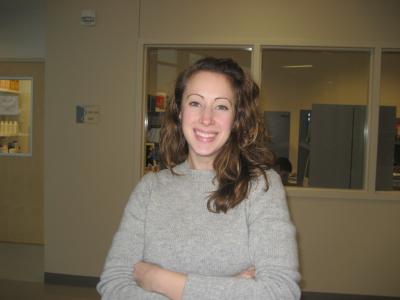
Natalie Ciaccio, a fourth-year graduate student researcher in the Department of Pharmaceutical Chemistry at the University of Kansas, is investigating what might be an ideal target for anti-cancer drug therapy, and she is focusing her work on brain tumors specifically. The National Cancer Institute estimates that in 2008, there were 21,810 diagnoses of brain tumors and other nervous system disorders in the United States. These cancers led to approximately 13,070 deaths. What's worse, in 2007 brain tumors were the leading cause of solid tumor death in children, constituting 21 percent of all childhood cancers.
"The current protocol of treatment involves major brain surgery to remove the tumor, followed by radiation and some type of chemo," said Ciaccio. "These can have terrible side effects and make you sick. So for patients, not only do they only have 12 to 18 months to live, but they can be very ill during that last year. So we'd like to find treatments that are more effective and have fewer side effects."
In the lab, Ciaccio has shown that hindering a protein called "activating transcription factor 5" killed cancerous brain cells — without harming surrounding, healthy brain tissue. Today, her work involves trying to better understand the structure of ATF5 and develop ways to target the protein. Working under faculty adviser Jennifer Laurence, assistant professor of pharmaceutical chemistry, Ciaccio spearheads the first group in the world to isolate ATF5 and study its makeup.
"If we have cancer in the brain and then we have normal tissue in the brain, ATF5 is something that's in the cancer but not in the normal tissue in the brain," Ciaccio said. "There's something the ATF5 is doing in the cancer. And if you stop ATF5, the cancer cells die and the tumor shrinks. It seems to be something very selective that we can use to target the cancer and not affect the normal cells of the brain."
Cicaccio believes that ATF5 helps growth and proliferation of cancerous cells in brain tumors, where the protein is abundant.
"It's known that ATF5 is required for brain development, but once we have adult brains and they're fully developed, we don't detect any ATF5 present in adult normal brains," Ciaccio said. "Somehow the instruction for the gene that regulates ATF5 gets turned on when it's not supposed to be on anymore. And maybe that's why we have high levels of ATF5 in the cancer. Then these cells start to grow uncontrollably — and that results in cancer."
To better understand ATF5, Cicaccio produces large quantities of the protein from genetically modified bacteria grown in her lab at the Multidisciplinary Research Building on KU's west campus. But proteins are complex. The KU researcher is focused on better mapping a domain of the protein called bZIP that binds to DNA, in the hopes of preventing it from attaching to genes and advancing cancer.
Ciaccio studies the ATF5 molecule's structure using KU's Nuclear Magnetic Resonance Laboratory — it houses a high-tech spectrometer akin to MRIs that are used in hospitals. The 800 MHz spectrometer provides detailed, three-dimensional computer models of the protein and helps Ciaccio better analyze the bZIP structure of the ATF5 protein. Someday, with a better grasp on the intricate arrangement of the molecule, scientists could find a way to target the protein and stunt cancerous growths.
But Ciaccio's work with ATF5 is still in the basic research stage, and the road toward a useful therapy can be a long one. Ciaccio estimates that it could take at least 10 years for her research to result in a drug that could be administered to patients.
"Ideally, we'd like to see this new type of treatment that will be developed prolong lives," said Ciaccio. "But if we could also provide treatment that would have less side effects than what's available now, I think patients would jump at the chance to take something that's going to treat their cancer without making them so ill."
The KU researcher knows well the suffering experienced by cancer patients. It's a motivating factor in making development of better cancer therapies the focus of her career.
"My grandfather died of leukemia when I was in junior high and he was very sick the last year of his life," Ciaccio said. "I think a lot of it was the treatment that was making him sick. And when he passed, he had been though so much pain and had lost so much weight that he didn't even look like himself anymore. So that started me thinking a long time ago that we have to be able to do better than this."
Already, Ciaccio's work with ATF5 is being funded and recognized for its significance. She received a prestigious Self Graduate Fellowship during her first year at KU.
"That's a unique program in that it's training graduate students to be leaders — to effectively communicate and write and network and work on a team," Ciaccio said. "All of the training that you need to be an effective leader you can get through the Self Graduate Program. I don't know of any other universities that have that for graduate students. Most of their training is usually scientific training, but people tend to neglect the skills that you need to succeed in the real world in terms of communication and learning to be a leader."
Most recently, Ciaccio presented her work to Kansas lawmakers at the Graduate Student Research Summit in Topeka, after placing highly in the recent Graduate Research Competition held at KU.
Source: University of Kansas
Other sources
- Graduate Student Researcher Takes Aim At Deadly Brain Tumorsfrom Science DailyFri, 3 Apr 2009, 13:21:33 UTC
- Researcher takes aim at deadly brain tumorsfrom PhysorgFri, 3 Apr 2009, 12:21:19 UTC