


Texas-sized tract of single-celled clones
Related images
(click to enlarge)
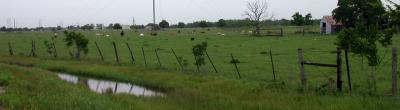
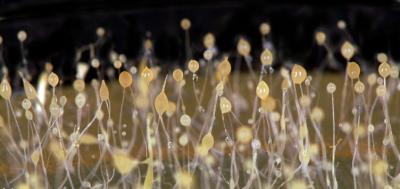
A Rice University study of microbes from a Houston-area cow pasture has confirmed once again that everything is bigger in Texas, even the single-celled stuff. The tests revealed the first-ever report of a large, natural colony of amoebae clones -- a Texas-sized expanse measuring at least 12 meters across. The research is available online and featured on cover of the March issue of Molecular Ecology.
Some large organisms like aspen trees and sea anemones are well-known for growing in large clonal colonies. For example, one colony of aspen clones in Utah contains more than 40,000 trees that share a massive root system.
In contrast, the short-lived patch of amoeba clones contained millions of genetically identical individuals of the species Dictyostelium discoideum. Though they typically live as loners, hunting and eating bacteria, D. discoideum are known to cooperate when food gets scarce and even to sacrifice their lives altruistically. Biologists say the discovery of the clonal colony could yield important clues about the evolution of such cooperative behavior.
"This discovery is important for our understanding of microbial social evolution because the processes of selection, cooperation and competition play out differently when populations are geographically mixed as opposed to being isolated in patches," said study co-author Joan Strassmann, the Harry C. and Olga K. Wiess Professor in Natural Sciences and chair of Rice's Department of Ecology and Evolutionary Biology.
Studies of clonal colonies in other species show that the colonies often appear at the edge of a species' natural range.
"People had seen this in studies of sea anemone and other species," said study co-author Owen Gilbert, a Rice graduate student in ecology and evolutionary biology. "There are thought to be two ways that these colonies can form at the edge of a species' natural range: either just one clone finds its way there, or perhaps a few make it there but they compete with each other and just one wins out."
Based on these studies, Strassmann, Gilbert and co-author and evolutionary biologist David Queller, Rice's Harry C. and Olga K. Wiess Professor of Ecology and Evolutionary Biology, surmised that clonal patches could form on the edge of a microbial species' range, and they looked for a suitable location to test the idea in D. discoideum.
"D. discoideum tends to thrive at higher altitudes and in densely wooded areas where the soil stays moist," Gilbert said. "A Texas cattle pasture is simply the wrong type of habitat. But D. discoideum thrives on the dung of various animals, which suggests that given a good amount of rain, a cattle pasture could be the perfect place for a population explosion."
Strassmann, Gilbert and a team of Rice undergraduate researchers took samples from 18 local pastures. In each, they plotted a grid and collected soil and dung samples. Back at the lab, they put the samples on clear plates and examined them daily to see whether they produced any feeding amoebae. When amoebae were found, they were analyzed genetically to see whether they were the same species, and if so, whether they were genetic clones.
In one of the fields, they found that all the D. discoideum samples were genetic clones. Subsequent tests in the lab showed that the strain didn't have a distinct competitive advantage over three other strains found in nearby pastures. Exactly how and why the large clonal patch appeared in that particular field isn't clear, but the fact that it was there raises some intriguing questions.
For example, Strassmann and Queller's prior work with D. discoideum has turned up more than 100 genes that help the organism regulate its cooperative behavior. They also know that mutations to these genes can allow individual amoebae to "cheat" and take advantage of nonmutants' willingness to sacrifice themselves. How species like D. discoideum manage to keep cheaters from out-producing and eliminating cooperative strains is one focus of their work.
"The existence of clonal patches in microbial species presents very interesting possibilities for the appearance and regulation of cheating behaviors," Queller said. "It is likely that additional natural studies of social microbes will continue to complement the genetic and evolutionary laboratory studies of these organisms."
Source: Rice University
Other sources
- Biologists Find World-record Colony Of Amoeba Clones In Texas Cow Pasturefrom Science DailyThu, 12 Mar 2009, 4:28:43 UTC
- Texas-sized tract of single-celled clonesfrom PhysorgWed, 11 Mar 2009, 18:28:34 UTC