


Into the eye of the helix
Related images
(click to enlarge)
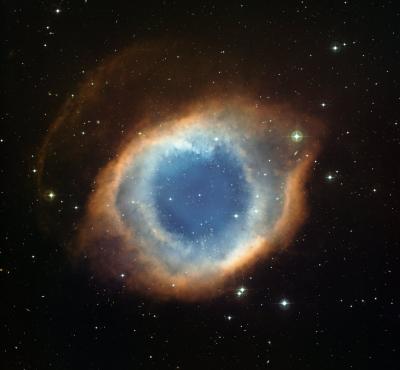
The Helix Nebula, NGC 7293, lies about 700 light-years away in the constellation of Aquarius (the Water Bearer). It is one of the closest and most spectacular examples of a planetary nebula. These exotic objects have nothing to do with planets, but are the final blooming of Sun-like stars before their retirement as white dwarfs. Shells of gas are blown off from a star's surface, often in intricate and beautiful patterns, and shine under the harsh ultraviolet radiation from the faint, but very hot, central star. The main ring of the Helix Nebula is about two light-years across or half the distance between the Sun and its closest stellar neighbour. Despite being photographically very spectacular the Helix is hard to see visually as its light is thinly spread over a large area of sky and the history of its discovery is rather obscure. It first appears in a list of new objects compiled by the German astronomer Karl Ludwig Harding in 1824. The name Helix comes from the rough corkscrew shape seen in the earlier photographs.
Although the Helix looks very much like a doughnut, studies have shown that it possibly consists of at least two separate discs with outer rings and filaments. The brighter inner disc seems to be expanding at about 100 000 km/h and to have taken about 12 000 years to have formed.
Because the Helix is relatively close — it covers an area of the sky about a quarter of the full Moon — it can be studied in much greater detail than most other planetary nebulae and has been found to have an unexpected and complex structure. All around the inside of the ring are small blobs, known as "cometary knots", with faint tails extending away from the central star. They look remarkably like droplets of liquid running down a sheet of glass. Although they look tiny, each knot is about as large as our Solar System. These knots have been extensively studied, both with the ESO Very Large Telescope and with the NASA/ESA Hubble Space Telescope, but remain only partially understood. A careful look at the central part of this object reveals not only the knots, but also many remote galaxies seen right through the thinly spread glowing gas. Some of these seem to be gathered in separate galaxy groups scattered over various parts of the image.
Source: ESO
Other sources
- New Picture Goes Into the Eye of the Helix Nebulafrom Space.comWed, 25 Feb 2009, 18:22:34 UTC
- Into the eye of the helixfrom PhysorgWed, 25 Feb 2009, 16:21:06 UTC
- Into The Eye Of The Helixfrom Science DailyWed, 25 Feb 2009, 13:22:02 UTC