


Tiny details in three dimensions
Related images
(click to enlarge)
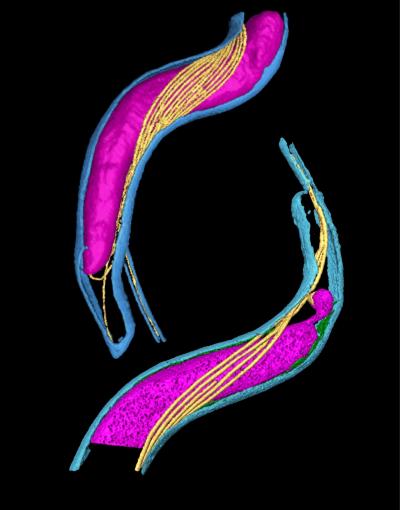
They are borne by ticks and can cause acute and chronic symptoms in joints, muscles and the nervous system – the bacteria that cause Lyme borreliosis, which 80,000 people in Germany contract every year. Heidelberg researchers have now succeeded in identifying their structure more accurately. Using a cryo-tomography microscope, the previously unknown detailed structure of the spirochete bacteria can be shown in three dimensions. One finding – that borrelia types in North America more often affect the joints and in Europe the skin and nervous system as well – seems to stem from the characteristics of their motility system. The research group headed by Professor Reinhard Wallich, Institute of Immunology, and Dr. Friedrich Frischknecht, Department of Parasitology at the Hygiene Institute of Heidelberg University Hospital has published its findings in cooperation with colleagues from Munich and Freiburg in "Molecular Microbiology". Among other things, the researchers hope to gain new insights into the various clinical symptoms of the disease.
Shock freezing maintains original condition / Resolution up to 5 nanometers
In cryo-electron tomography the organism is shock frozen so that its original condition is retained. Chemical pretreatment, which is often associated with modifying structures and properties, is no longer necessary. Resolution of five to seven nm allows tiniest structures to be viewed. "The new technology is a quantum leap for research, comparable with the step from simple x-ray images to three-dimensional computer tomography in clinical diagnostics," stated Dr. Frischknecht.
The bacteria have developed many strategies to avoid the immune response of humans. Borrelias, like the syphilis pathogens, are spirochetes bacteria. The spiral-shaped, actively motile bacteria have flexible, pliable bodies that are moved with the aid of complex organs, flagella. A correlation between the motility and infectiousness of the pathogen has long been presumed.
The Heidelberg researchers have now for the first time compared the characteristics of the three human pathogenic species that cause Lyme borreliosis that occur in Europe and cause varying symptoms. While in North America, the major symptom is joint inflammation, in Europe, the skin or nervous system may also be affected. With the aid of cryo-tomographic microscopy, they have successfully shown that the three pathogen types have varying numbers of flagella. In addition, structures were identified for the first time that could play an important role in the reproduction of the bacteria.
Source: University Hospital Heidelberg
Other sources
- Structure Of Bacteria That Causes Lyme Disease Detailed In 3Dfrom Science DailyFri, 13 Feb 2009, 19:28:29 UTC
- Tiny details in three dimensionsfrom PhysorgFri, 13 Feb 2009, 18:42:06 UTC