


ISU researchers develop technique for quick detection of Salmonella
Related images
(click to enlarge)
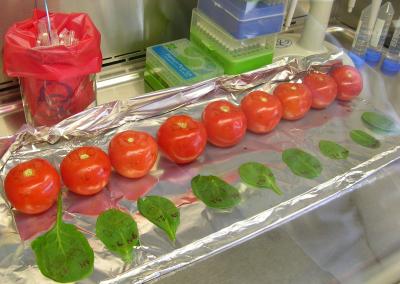
In the hours following an outbreak of Salmonella, there are many questions. And answers can be hard to find. Where did the problem start? Can it be contained? Is the sickness likely to spread?
Iowa State University researchers have developed a technique for testing for the presence of Salmonella that may give investigators better, faster answers.
The process, developed by Byron Brehm-Stecher, assistant professor in food science and human nutrition, and his graduate student Bledar Bisha, begins with testing the food, in most cases produce, with a strip of adhesive tape.
The tape is applied to the produce, then carefully removed, taking a sample of whatever is on the skin of the produce. That sample is then put on a slide and soaked in a special warm, soapy mixture that contains a genetic marker that binds with Salmonella and gives off a fluorescent glow when viewed under an ultraviolet light. Use of this genetic marker approach is called Fluorescent In-Situ Hybridization, or FISH.
The approach can tell investigators if the produce is contaminated with Salmonella in about two hours.
"This method is rapid, it's easy, and it's cheap," said Brehm-Stecher.
Current methods of detecting Salmonella take one to seven days.
Brehm-Stecher and Bisha call the process "tape-FISH" and note that it could be an important technique for Salmonella investigators.
"I think this will be good tool in outbreak investigation and routine surveillance especially since all you need is tape, a heat block, a small centrifuge and a fluorescence microscope," said Brehm-Stecher. "It has the potential to be very portable."
Brehm-Stecher's and Bisha's findings will be published in the journal Applied and Environmental Microbiology, published by the American Society of Microbiology.
Once at a location where an outbreak of Salmonella has occurred, investigators can test the produce for contamination. Outbreaks can be due to other factors such as food preparation.
Once investigators find the origin of the Salmonella, they can take steps to contain it, said Brehm-Stecher.
Salmonella can be found on produce such as tomatoes, cilantro, peppers, spinach and others. The produce can be contaminated while it is in the fields or during processing. Washing the produce thoroughly can help, but cannot ensure the produce will be safe.
The tape-FISH technique can also be used to test produce that is not suspected of being contaminated, but the volume of produce that would need to be tested may make this impractical. However, the technique could be very valuable as a basic research tool. Researchers could investigate how Salmonella and other types of organisms interact on produce surfaces, said Brehm-Stecher.
This is the first application of tape-FISH to Salmonella, but the idea came to the ISU researcher while reading about art restoration.
In 2008, Brehm-Stecher read about an Italian group that was using a similar approach to look for bacteria on ancient catacombs. Those researchers were hoping to identify and remove bacteria that were slowly eating away at the relics.
After some classroom discussion with his students, Brehm-Stecher decided that using the FISH on produce could be useful and began researching the idea with Bisha. Together, they were able to apply the method to produce and made several improvements in speed and sensitivity over the existing tape-FISH approach. Brehm-Stecher hopes that his tape-FISH approach can help speed investigations of produce contamination, such as last summer's outbreak of Salmonella Saintpaul, which was eventually traced to imported jalapeno and Serrano peppers.
Source: Iowa State University
Other sources
- New Technique Developed For Quick Detection Of Salmonellafrom Science DailyMon, 2 Feb 2009, 18:28:04 UTC
- Researchers develop technique for quick detection of Salmonellafrom PhysorgMon, 2 Feb 2009, 18:21:12 UTC