


Climate change enhances grassland productivity
Related images
(click to enlarge)
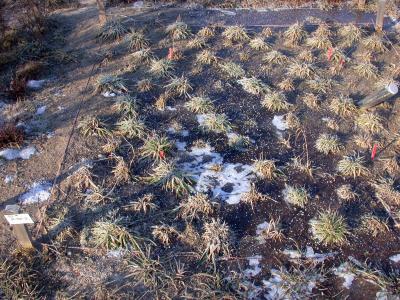

Bayreuth/Leipzig. More frequent freeze-thaw cycles in winter can increase biomass production according to the results of a recent study conducted by the Helmholtz Center for Environmental Research (UFZ), the University of Bayreuth and the Helmholtz Center in Munich. For their experiment at the Ecological-Botanical Garden of the University of Bayreuth the researchers installed underground heating on their plots, thereby enabling five additional thawing periods to take place in the winter of 2005/2006. They found that on the manipulated plots ten percent more biomass grew compared to on the control plots. Such increased plant productivity can be explained by several factors, like for example an increase in nitrogen supply in the spring, according to the researchers account in the scientific journal New Phytologist. Soils that experience seasonal freeze-thaw cycles currently cover c. 55 million km2. This equates to more than half of the total land area of the northern hemisphere. Forecasts such as the IPCC-Report 2007 anticipate that due to global warming the soil temperature there in the future will fluctuate more frequently around the freezing point. The change between freeze-thaw cycles is considered to be one of the major factors for the release of nitrogen into the soil and consequently for an increase in microbial activity.
Due to global warming and a greater absence of an insulating snow cover, these cyclic processes are likely to increase. In spite of this and apart from a study from the North of Sweden there are hitherto practically no investigations that have conducted research on the significance of these cyclic processes for plants. Scientists working together with Jürgen Kreyling therefore set up an experimental site on the outskirts of Bayreuth to investigate the effects of extreme weather events such as droughts, torrential rain and freeze-thaw processes. The site is located at the transition between oceanic and continental climates, where the average air temperature in January is -1° C. On 30 of the 4m2 plots one hundred common plants (grasses and herbs) were planted. As soon as the temperature had remained continuously below 0° C for 48 hours the soil was heated until the temperature remained above 0° C for 48 hours. In the cold winter of 2005/06, which was 2° C colder than the long-term average, there were a total of 62 days with ground frost. The researchers added 5 artificial freeze-thaw cycles to the three natural ones and compared the results from the different plots. In the following summer the plants were harvested twice, dried and then weighed. Here it was found that the manipulated plots produced 10 percent more above-ground biomass than the control plots on which in the previous winter less freeze-thaw cycles had occurred. In comparison it was also found that root length up to five centimetres soil depth was reduced.
Source: Helmholtz Association of German Research Centres
Other sources
- Climate change enhances grassland productivityfrom PhysorgMon, 26 Jan 2009, 17:28:22 UTC
- Climate Change Enhances Grassland Productivity: More Frequent Freeze-thaw Cycles Intensify Soil Processesfrom Science DailyMon, 26 Jan 2009, 15:21:43 UTC