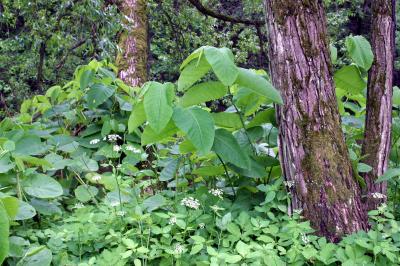
Invasions by alien plants have been mapped in European Union
Biological invasions are one of the major threats to biodiversity and in many cases they have considerable impact on economy and human health. For their effective management it is important to understand which areas and ecosystems are at the highest risk of being invaded. The first map of the level of alien plant invasions in European Union was published in the Wiley-Blackwell journal Diversity and Distributions.
An international team of Czech, Spanish and British plant ecologists investigated species composition of vegetation in more than 50 000 sites in northwestern, southern and central Europe. In each of these sites they quantified the proportion of alien to native plant species.
"We found that the highest risk of alien plant invasions was in agricultural and urban ecosystems. Low levels of invasion were in natural and semi-natural grasslands and most woodlands, and the lowest levels in the Mediterranean evergreen vegetation, heathlands and peatlands. This pattern was quite consistent among European regions with contrasting climates, biogeography, history and socio-economic background", said senior author Milan Chytrý from Masaryk University, Brno, Czech Republic.
"The level of plant invasions basically depends on the distribution of different ecosystem types across Europe. High levels of invasion are typical of lowland areas of western and central Europe while low levels are found in northern Europe and mountain regions across the continent. Low levels of invasion also occur in the Mediterranean region except its coastline and irrigated fields", added Petr Pyšek from the Institute of Botany Průhonice, Academy of Sciences of the Czech Republic.
Source: Wiley-Blackwell
Related
- 11,000 alien species invade EuropeThu, 20 Nov 2008, 14:57:07 EST
- Woody and aquatic plants pose greatest invasive threat to ChinaThu, 1 May 2008, 6:14:26 EDT
- Climate change opens new avenue for spread of invasive plantsWed, 19 Nov 2008, 15:50:44 EST
- Northwestern United States could face more tamarisk invasion by century's endTue, 15 Sep 2009, 15:10:03 EDT
- Scientist names top 5 invasive plants threatening Southern forests in 2009Mon, 12 Jan 2009, 14:28:46 EST
Other sources
- Invasions by alien plants have been mapped in Europefrom Science CentricThu, 22 Jan 2009, 15:21:45 EST
- Invasions by alien plants have been mapped in Europefrom PhysorgThu, 22 Jan 2009, 10:07:35 EST
- Five Invasive Plants Threatening Southern Forests In 2009 Identifiedfrom Science DailyMon, 19 Jan 2009, 23:14:25 EST
Latest Science Newsletter
Get the latest and most popular science news articles of the week in your Inbox!Learn more about
Popular science news articles
- First black holes may have incubated in giant, starlike cocoons, says CU-Boulder study
- Polyphenols and polyunsaturated fatty acids boost the birth of new neurons
- Molecule discovered that makes obese people develop diabetes
- Report shows dramatic decline in Siberian tigers
- New tool for helping pediatric heart surgery
- Beyond sunlight: Explorers census 17,650 ocean species between edge of darkness and black abyss
- Generating electricity from air flow
- Therapy 32 times more cost effective at increasing happiness than money
- Beyond genomics, biologists and engineers decode the next frontier
- It's a gas: New discovery may lead to heartier, high-yielding plants
- Therapy 32 times more cost effective at increasing happiness than money
- Full recovery now possible for an 'untreatable' mental illness
- 5 exercises can reduce neck, shoulder pain of women office workers
- Beyond sunlight: Explorers census 17,650 ocean species between edge of darkness and black abyss
- Surface bacteria maintain skin's healthy balance
- New evidence that dark chocolate helps ease emotional stress
- African desert rift confirmed as new ocean in the making
- Scientists discover influenza's Achilles heel: Antioxidants
- Nanoparticles used in common household items caused genetic damage in mice
- New study links vitamin D deficiency to cardiovascular disease and death