


Electronics from the printer
Related images
(click to enlarge)
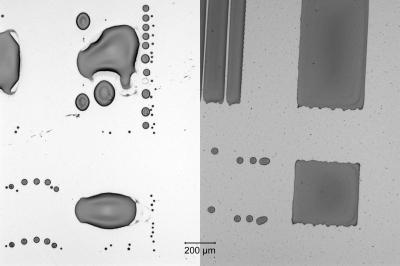
Televisions have changed dramatically: While bulky TV sets dominated our living rooms until just a few years ago, the screens are now so flat that they can easily be hung on the wall. A close look at the inside of these devices will reveal fine conductor paths and transistors that supply the electricity needed to switch the pixels on the screen on and off. These circuits are manufactured layer by layer, usually by photolithography. The materials are deposited onto the entire surface of a substrate and covered with photoresist, which is exposed to light at specific points using a mask. The exposed photoresist alters its chemical properties: It becomes soluble and can be easily removed. The layer to be structured returns to the surface and can be etched away. However, the parts of the layer still covered with photoresist remain intact. One major disadvantage of this process is that a large fraction of the deposited material is not used. A more cost-efficient and resource-saving method is to deposit the material by printing only in places where it will actually be needed later. Printed electronics already exist in the form of conductor paths and devices made from polymers. However, their electrical properties cannot compete with those of inorganic materials. The charge carriers in the polymers travel more slowly, with the result that a printed RFID tag, for example, will have a shorter transmission range than a conventional one. Moreover, polymers tend to react more sensitively to moisture and UV light. Researchers at the Fraunhofer Institute of Integrated Systems and Device Technology IISB in Erlangen have now commissioned a process line in which electron devices can be printed from inorganic materials using an ink jet similar to those in any office printer. "We use ink made of nanoparticles and add a stabilizer so that the particles can be easily processed and do not clump together," says IISB group manager Dr. Michael Jank.
The nano ink has passed the first printing tests and Jank hopes that the researchers will be able to print circuits performing simple functions in about a year's time. "We expect printed products to cost around 50 percent less than silicon-based ones in the case of simple circuits," he says. "Printed RFID tags should then be cheap enough to be attached to the packaging of low-cost products such as yogurts, where they can then monitor the temperature, and store and transmit data."
Source: Fraunhofer-Gesellschaft
Articles on the same topic
- Spin-polarized electrons on demandWed, 21 Jan 2009, 19:28:37 UTC
Other sources
- New Development in Spintronics: Spin-polarized Electrons On Demand, With A Single Electron Pumpfrom Science DailyThu, 22 Jan 2009, 0:21:44 UTC
- Spin-polarized electrons on demandfrom PhysorgWed, 21 Jan 2009, 19:28:10 UTC
- Electronics Created With Printer Significantly Improvedfrom Science DailyMon, 19 Jan 2009, 14:21:46 UTC