


Cold atoms could replace hot gallium in focused ion beams
Related images
(click to enlarge)
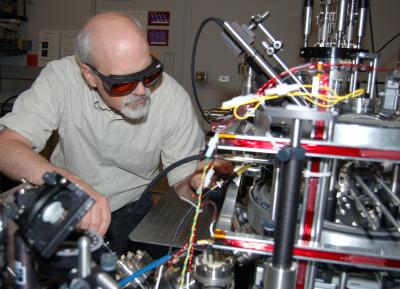
Scientists at the National Institute of Standards and Technology (NIST) have developed a radical new method of focusing a stream of ions into a point as small as one nanometer (one billionth of a meter).* Because of the versatility of their approach—it can be used with a wide range of ions tailored to the task at hand—it is expected to have broad application in nanotechnology both for carving smaller features on semiconductors than now are possible and for nondestructive imaging of nanoscale structures with finer resolution than currently possible with electron microscopes. Researchers and manufacturers routinely use intense, focused beams of ions to carve nanometer-sized features into a wide variety of targets. In principle, ion beams also could produce better images of nanoscale surface features than conventional electron microscopy. But the current technology for both applications is problematic. In the most widely used method, a metal-coated needle generates a narrowly focused beam of gallium ions. The high energies needed to focus gallium for milling tasks end up burying small amounts in the sample, contaminating the material. And because gallium ions are so heavy (comparatively speaking), if used to collect images they inadvertently damage the sample, blasting away some of its surface while it is being observed. Researchers have tried using other types of ions but were unable to produce the brightness or intensity necessary for the ion beam to cut into most materials.
The NIST team took a completely different approach to generating a focused ion beam that opens up the possibility for use of non-contaminating elements. Instead of starting with a sharp metal point, they generate a small "cloud" of atoms and then combine magnetic fields with laser light to trap and cool these atoms to extremely low temperatures. Another laser is used to ionize the atoms, and the charged particles are accelerated through a small hole to create a small but energetic beam of ions. Researchers have named the groundbreaking device "MOTIS," for "Magneto-Optical Trap Ion Source." (For more on MOTs, see "Bon MOT: Innovative Atom Trap Catches Highly Magnetic Atoms," NIST Tech Beat Apr. 1, 2008.)
"Because the lasers cool the atoms to a very low temperature, they're not moving around in random directions very much. As a result, when we accelerate them the ions travel in a highly parallel beam, which is necessary for focusing them down to a very small spot," explains Jabez McClelland of the NIST Center for Nanoscale Science and Technology. The team was able to measure the tiny spread of the beam and show that it was indeed small enough to allow the beam to be focused to a spot size less than 1 nanometer. The initial demonstration used chromium atoms, establishing that other elements besides gallium can achieve the brightness and intensity to work as a focused ion beam "nano-scalpel." The same technique, says McClelland, can be used with a wide variety of other atoms, which could be selected for special tasks such as milling nanoscale features without introducing contaminants, or to enhance contrast for ion beam microscopy.
Source: National Institute of Standards and Technology (NIST)
Other sources
- Cold Atoms Could Replace Hot Gallium in Focused Ion Beamsfrom Newswise - ScinewsThu, 13 Nov 2008, 22:21:14 UTC
- Cold atoms could replace hot gallium in focused ion beamsfrom PhysorgThu, 13 Nov 2008, 18:35:13 UTC