


DNA research taking guesswork out of finding the 'therapeutic window'
Related images
(click to enlarge)
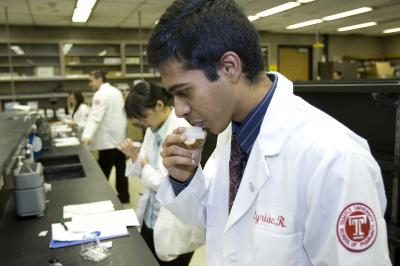
It's only spit, but what's inside your saliva may help solve a dosing dilemma facing doctors and patients. By using DNA to customize prescriptions, researchers at Temple University's School of Pharmacy are working to prevent adverse drug reactions before you even take the first dose. Each year, adverse drug reactions kill or injure more than 770,000 people in this country, according to the U.S. Department of Health & Human Services. At the top of the list of problem drugs is Warfarin, (Coumadin®), the most widely prescribed anticoagulant. That is why Evgeny Krynetskiy, Ph.D., associate professor and director of the Jayne Haines Center for Pharmacogenomics and Drug Safety, has focused his research efforts on that drug. "Prescribing this medicine is like trial and error in finding the right dosage that works best for you," says Krynetskiy. "Five milligrams is a typical dose, but a little less or a little more could have dramatic consequences or no benefit at all."
Doctors call this optimal dosage the therapeutic window, and Krynetskiy is trying to find it through pharmacogenomics, the study of a person's response to drugs based on their genetic makeup. It's a collaboration that crosses campuses and includes Krynetskiy and fellow clinical faculty at the School of Pharmacy, clinicians at Temple University Hospital and Jeannes Hospital. The researchers are studying why people process the same drug differently. In this case, they're trying to find the correlation between genotypes, or a person's inner code of DNA, and the correct dosage of Warfarin. By collecting saliva samples and extracting DNA from 77 participants already on the drug, the researchers can look for variances, genetic clues, which make people metabolize the same drug in very different ways.
"Our findings have confirmed there is a genetic variance of certain genotypes that correlate to how these participants respond to this drug," says co-investigator Nima Patel, Pharm. D., associate professor in the School of Pharmacy. "So, if you have this genotype, we can conclude what your risks may be, based on your DNA."
That would allow doctors to prescribe the correct dosage of Warfarin and decrease the risk of adverse drug reactions: Too low a dose can increase the risk of dangerous blood clots, while too large can cause life-threatening bleeding. What may be equally noteworthy about Krynetskiy's and Patel's research is that more than half the participants are either African American or Hispanic, two groups underrepresented in clinical trials. So, finding their therapeutic window, the place where they will safely get the maximum benefit of a drug, is particularly important in this personalized medicine quest.
Source: Temple University
Other sources
- DNA research taking guesswork out of finding the 'therapeutic window'from PhysorgThu, 23 Oct 2008, 16:28:53 UTC