


New study will make criminals sweat
Related images
(click to enlarge)
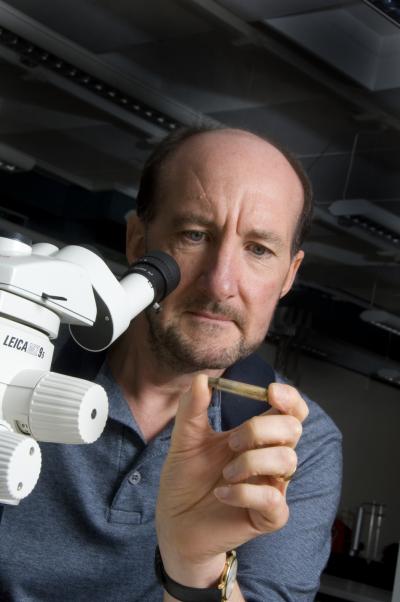
The inventor of a revolutionary new forensic fingerprinting technique claims criminals who eat processed foods are more likely to be discovered by police through their fingerprint sweat corroding metal. Dr John Bond, a researcher at the University of Leicester and scientific support officer at Northamptonshire Police, said processed food fans are more likely to leave tell-tale signs at a crime scene.
Speaking before a conference on forensic science at the University of Leicester, Dr Bond said sweaty fingerprint marks made more of a corrosive impression on metal if they had a high salt content.
And he revealed he was currently in early talks with colleagues at the University of Leicester to assess whether a sweat mark left at a crime scene could be analysed to reveal a 'sweat profile' ie more about the type of person who left the mark.
Dr Bond, from Northamptonshire Police Scientific Support Unit is an Honorary Research Fellow at the University of Leicester's Forensic Research Centre. He has developed a method that enables scientists to 'visualise fingerprints' even after the print itself has been removed. He and colleagues conducted a study into the way fingerprints can corrode metal surfaces. The technique can enhance – after firing– a fingerprint that has been deposited on a small calibre metal cartridge case before it is fired.
Dr Bond said: "On the basis that processed foods tend to be high in salt as a preservative, the body needs to excrete excess salt which comes out as sweat through the pores in our fingers.
"So the sweaty fingerprint impression you leave when you touch a surface will be high in salt if you eat a lot of processed foods -the higher the salt, the better the corrosion of the metal."
Dr Bond added there was therefore an indirect link therefore between obesity and the chances of being caught of a crime. "Other research has drawn links between processed foods and obesity and we know that consumers of processed foods will leave better fingerprints," he said.
Dr Bond said there was scope to take his research further and to look at the constituents of sweat itself in order to profile an individual: "We are currently in talks with the University of Leicester to see if there is scope to investigate sweat itself and whether it can identify the type of person who left that sweat mark.
"This is because the amount of sweat people leave varies and the components of the sweat varies. Important for us is how the salt varies but there is potential to investigate other elements to describe the kind of person who left the mark. It would give lifestyle information that, whilst nowhere near as good as identifying individuals with their fingerprints, it is still very good for police if they have got nothing else to go on.
"This would be particularly helpful for terrorist type crimes where the nature of the incident would tend to obliterate forensic evidence. So a sweat mark on a piece of metal or bomb fragment that might be recovered from an incident might be able to provide a clue to the type of person who perpetrated the incident."
"We would describe the study of sweat as a process of intelligent fingerprinting - using the fingerprint to tell us more about the individual rather than a simple identification."
Source: University of Leicester
Other sources
- Criminals Who Eat Processed Foods More Likely To Be Discovered, Through Fingerprint Sweat Corroding Metalfrom Science DailyThu, 18 Sep 2008, 21:28:44 UTC
- Fast-food could betray criminalsfrom BBC News: Science & NatureTue, 16 Sep 2008, 12:35:29 UTC
- New study will make criminals sweatfrom PhysorgTue, 16 Sep 2008, 10:42:15 UTC
- Criminals Who Eat Processed Foods More Likely To Be Discovered, Through Fingerprint Sweat Corroding Metalfrom Science DailyTue, 16 Sep 2008, 2:21:04 UTC