


Novel tuberculosis vaccine in Germany in clinical phase
Related images
(click to enlarge)
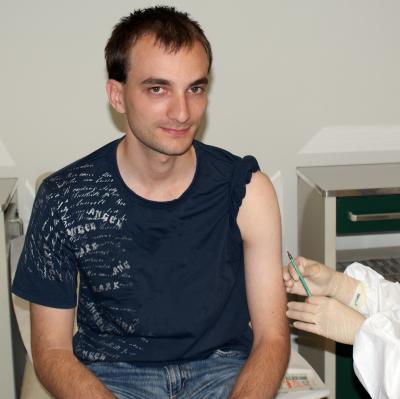
For the first time in more than 80 years a promising live vaccine against tuberculosis has passed into the clinical phase in Germany: Since Monday of this week the new vaccine, which goes by the designation "VPM1002", has begun safety testing on volunteers in a Phase I clinical trial in Neuss, Germany. It is based on a highly safe vaccine that was introduced in 1921. However, the vaccine has been genetically developed to an extent where it is significantly more effective at preventing infection with tuberculosis bacteria than its predecessor. So far, VPM1002 has proved to be extremely effective and safe in animal models. „ This good protection now has to be proven in humans for the vaccine to be ready for the final approval," explains the Chief Executive Officer of Vakzine Projekt Management GmbH (VPM), Bernd Eisele. VPM coordinates application-oriented development of vaccines. The organisation is a public-private partnership established by the Federal Ministry of Education and Research (BMBF) and Helmholtz Centre for Infection Research in 2002. „ We ensure that the outstanding results of basic science are actually used for the good of mankind and make their way into use," says the Clinical Project Manager Hans von Zepelin. In this, the superb contacts enjoyed by VPM within German science prove a great aid, as the Scientific and Technical Services Manager at the Helmholtz Centre for Infection Research, Rudi Balling, states: "VPM knows exactly where promising projects can be found. With their assistance we, the researchers, can show that our ideas are helping people to stay healthy."
With the financial support of the BMBF VPM was able to licence the novel tuberculosis vaccine from the Max Planck Institute for Infection Biology. The scientific foundation was established in this institute by its Founding Director Stefan H.E. Kaufmann. "The new vaccine is based on the most administered live-vaccine worldwide: Bacille Calmette-Guérin (BCG). However, BCG often fails to display effects anymore. We wanted to sharpen the blunted weapon that is BCG once again."
How this was achieved is described by Leander Grode, at that time a research assistant with Stefan H.E. Kaufmann and now Project Manager at VPM: "The weakened vaccine was genetically modified in such a way to ensure that it is no longer able to hide from the human immune system and even stimulates the body's own defences now." For that a gene of a different bacterium, Listeria, was inserted into the vaccine. "Macrophages of the human immune system take up the vaccine immediately. There it ends up in phagosomes", says Grode. "Due to the genetic modification the bacteria can leave the phagosomes and are then present in the middle of the immune cell – this alarms the rest of the immune system, which is then armed to repel real tuberculosis pathogens."
Source: Helmholtz Association of German Research Centres
Articles on the same topic
- Clinical trial for new tuberculosis vaccineThu, 11 Sep 2008, 15:16:52 UTC
Other sources
- Clinical Trial For New Tuberculosis Vaccinefrom Science DailyThu, 11 Sep 2008, 15:42:59 UTC
- Clinical trial for new tuberculosis vaccinefrom PhysorgThu, 11 Sep 2008, 15:15:01 UTC