


Tel Aviv University researchers root out new and efficient crop plants
Related images
(click to enlarge)
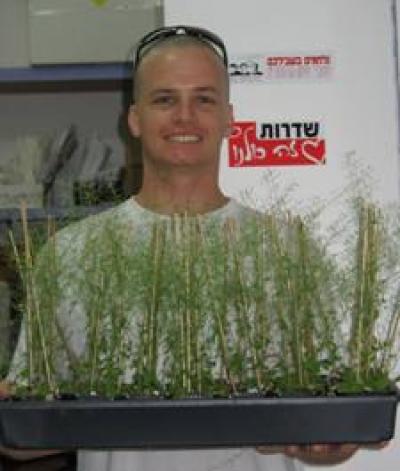
A part of the global food crisis is the inefficiency of current irrigation methods. More irrigated water evaporates than reaches the roots of crops, amounting to an enormous waste of water and energy. Tel Aviv University researchers, however, are investigating a new solution that turns the problem upside-down, getting to the root of the issue. They are genetically modifying plants' root systems to improve their ability to find the water essential to their survival.
The Root Cause of Wasting Water
When it comes to water, every drop counts. "Improving water uptake by irrigated crops is very important," says Prof. Amram Eshel, the study's co-researcher from Tel Aviv University's Plant Sciences Department. His team, with that of Prof. Hillel Fromm, hope to engineer a plant that takes advantage of a newly discovered gene that controls hydrotropism, a plant's ability to send its roots towards water.
Scientists in TAU's lab are observing plants that are grown on moist air in the University's lab, making it possible to investigate how the modified plant roots orient themselves towards water. Until now, aeroponics (a method of growing plants in air and mist) was a benchtop technique used only in small-scale applications. The current research is being done on the experimental model plant Arabidopsis, a small flowering plant related to cabbage and mustard.
Environmental Consequences Have Economic Consequences Too
"Our aim is to save water," explains Prof. Eshel. "We are increasing a plant's efficiency for water uptake. Plants that can sense water in a better fashion will be higher in economic value in the future."
There can be significant water-saving consequences for farmers around the world. "We are developing plants that are more efficient in sensing water," says research doctoral student Tal Sherman, who is working under Prof. Amram Eshel and Prof. Hillel Fromm. The project is funded by a grant from the Israeli Ministry of Agriculture and Rural Development to Prof. Fromm and Prof. Eshel.
Ideas Planted in Darwin's Time
In the nineteenth century, scientists were already observing that plant roots naturally seek out the wetter regions in soil.
Although the phenomenon is well documented, scientists until recently had no clue as to how the mechanism worked, or how to make it better. New insights from the Tel Aviv University study could lead to plants that are super water seekers, say researchers.
Source: American Friends of Tel Aviv University
Other sources
- Plants' ability to find water is studiedfrom UPIThu, 31 Jul 2008, 17:35:12 UTC
- Researchers root out new and efficient crop plantsfrom PhysorgWed, 30 Jul 2008, 20:14:35 UTC