


Bees go 'off-color' when they are sickly
Related images
(click to enlarge)
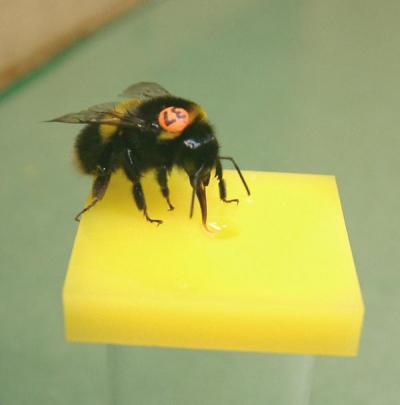
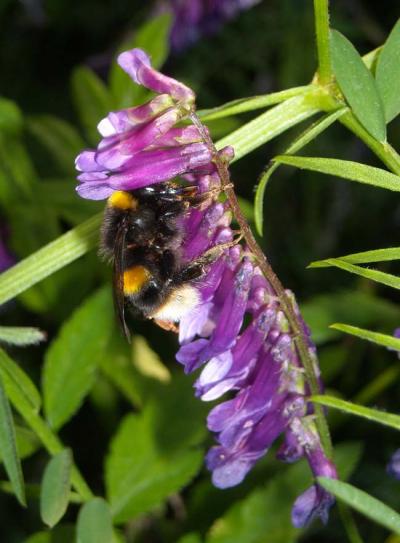
Bumble-bees go 'off colour' and can't remember which flowers have the most nectar when they are feeling under the weather, a new study from the University of Leicester reveals. The behaviour of the bumbling bees is reported in the Royal Society journal Biology Letters published today (Wednesday 16 July.) It reveals that, like humans who are ill, bees are often not at their most astute and clever when they feel poorly.
Lecturer in Animal Biology at the University of Leicester Dr. Eamonn Mallon, who lead the research group, said: "Disease can influence different behaviours including foraging, mate choice, and predator avoidance. Several recent papers have shown reduced learning abilities in infected insects. However, it is difficult to separate the effects of the immune response from the direct effects of the parasite. That was the purpose of our study"
Bees were divided into a control group and a group that were injected with lipopolysaccharide, a substance that stimulated an immune response without a need for the bee to be infected with a disease. Bees were offered the choice of blue and yellow artificial flowers only one type of which contained sugar water. An individual's flight was recorded over ninety visits to these flowers. Eventually the bees spent almost all of their time going to the rewarding flowers, but it took the immune stimulated bees longer to reach this point.
The research, 'Immune response impairs learning in free flying bumble-bees', was conducted in the Department of Biology, in collaboration with the Department of Genetics, at the University of Leicester.
Dr Mallon added: "This work has two important applications. Firstly, there is a lot of interest in the connections between the immune system and the nervous system in human biology. The Mallon lab was the first to show that these interactions also exist in the much more experimentally tractable insects.
"Secondly, there is concern about both the decline in wild bumble-bee species and the effects of disease on the honeybee industry. It has been shown that learning is vitally important to how well a colony prospers. This effect of immunity on learning highlights a previously unconsidered effect of disease on colony success."
Future work will look at the basis of this neuro-immune interaction. Is it due to the immune system using up some resource required to form memories or is it due to the damaging effects of the immune response on the nervous system?
Source: University of Leicester
Other sources
- Bees Go 'Off-color' When They Are Sicklyfrom Science DailySat, 19 Jul 2008, 0:21:09 UTC
- Bees go 'off-color' when they are sicklyfrom PhysorgWed, 16 Jul 2008, 9:49:18 UTC