


Hebrew University research on octopuses sheds light on memory
Related images
(click to enlarge)
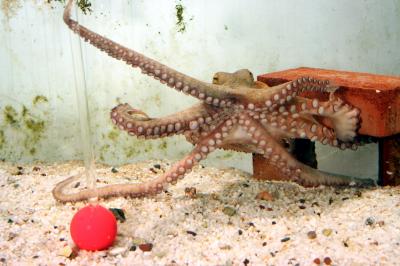
Research on octopuses has shed new light on how our brains store and recall memory, says Dr. Benny Hochner of the Department of Neurobiology at the Alexander Silberman Institute of Life Sciences at the Hebrew University of Jerusalem. Why octopuses?
Octopuses and other related creatures, known as cephalopods, are considered to be the most intelligent invertebrates because they have relatively large brains and they can be trained for various learning and memory tasks, says Dr. Hochner.
Their behavior repertoire and learning and memory abilities are even comparable in their complexity to those of advanced vertebrates. However, they are still invertebrate mollusks with brains that contain a much fewer number of nerve cells and much simpler anatomical organization than that of vertebrate brains. This unique constellation was utilized to tackle one of the most interesting questions in modern neuroscience, which is how the brain stores and recalls memories
In a previous study, Hochner discovered that an area in the octopus brain that was known to be important for learning and memory showed a robust, activity-dependent, long-term synaptic potentiation (LTP) – a process which is strikingly similar to that discovered in vertebrate brains.
This LTP process accelerates the transformation of information between nerve cells by enhancing the transmission of electrical signals through a special structure called the synapse for days and even a lifetime. It is believed that in the area in the brain that stores memories, the synaptic connections between nerve cells that are more active during a specific learning function are strengthened by this activity-induced LTP. One can describe this process as an "engraving of memory traces" in the neuronal networks that store information for a long time, says Hochner.
In a recent article in the journal, Current Biology, Hochner described how he tested these hypotheses and ideas in the brain of the octopus. He blocked the ability of the brain to use LTP during learning by utilizing artificial LTP and though electrical stimulation.
When LTP was blocked with this technique shortly before training for a specific task, the experimental group of octopuses did not remember well the task when tested for long-term memory the day after training. Similar results were obtained when sensory information was prevented from getting into the learning and memory area by lesioning a specific connection in the brain. These findings therefore support the finding that LTP is indeed important for creating memories.
The fact that this was revealed in an invertebrate suggests that this process (LTP) is an efficient mechanism for mediation of learning and memory. The research results in the octopuses also shed new light on how memory systems are organized. Even if one accepts that LTP is important for learning and memory, however, Hochner stresses that further research will be required to understand how this cellular process is utilized in other animal or human brains for storing memories and how these memories are recollected.
The results can also have implications with respect to the organization of learning and memory systems, says Hochner. It is documented that memory processes can be divided into a short-term memory of minutes or a few hours and long-term memory that can store important events and facts for days or even our entire lifetime. Interestingly, notes Hochner, his results show that as in mammals, including humans, the short and long-term memory in the octopus are segregated into two separate systems, each in different locations in the brain.
It is not completely understood how these two systems are interconnected, if at all. However, the organization in the octopus demonstrates a sophistication that was not described yet in other animals. In the octopus, the short-term and long-term systems are working in parallel, but not independently. This is so because the long-term memory area -- in addition to its capacity to store long-term memories -- also regulates the rate at which the short-term memory system acquires short-term memories. This regulatory mechanism is probably useful in cases where faster learning is significant for the octopus' survival in emergency or risky situations.
Source: The Hebrew University of Jerusalem
Other sources
- New Research On Octopuses Sheds Light On Memoryfrom Science DailyTue, 17 Jun 2008, 23:14:06 UTC
- New research on octopuses sheds light on memoryfrom PhysorgTue, 17 Jun 2008, 15:42:23 UTC