


Wandering poles left scars on Europa
Related images
(click to enlarge)
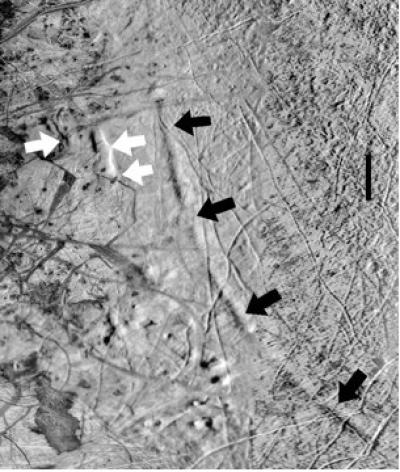
Curved features on Jupiter’s moon Europa may indicate that its poles have wandered by almost 90°, report scientists from the Carnegie Institution, Lunar and Planetary Institute, and University of California, Santa Cruz in the 15 May issue of Nature. Such an extreme shift suggests the existence of an internal liquid ocean beneath the icy crust, which could help build the case for Europa as possible habitat for extraterrestrial life. The research team, which included Isamu Matsuyama of the Carnegie Institution’s Department of Terrestrial Magnetism, used images from the Voyager, Galileo, and New Horizons spacecraft to map several large arc-shaped depressions that extend more than 500 kilometers across Europa’s surface. With a radius of about 1500 kilometers, Europa is slightly smaller than the Earth’s moon.
By comparing the pattern of the depressions with fractures that would result from stresses caused by a shift in Europa’s rotational axis, the researchers determined that the axis had shifted by approximately 80°. The previous axis of rotation is now located about 10° from the present equator.
The drastic shift in Europa’s rotational axis was likely a result of the build-up of thick ice at the poles. “A spinning body is most stable with its mass farthest from its spin axis,” says Matsuyama. “On Europa, variations in the thickness of its outer shell caused a mass imbalance, so the rotation axis reoriented to a new stable state.”
Such a change is called “true polar wander” as opposed to apparent polar wander caused by plate tectonics. There is evidence for true polar wander on Earth, and also on Mars and on Saturn’s moon Enceladus. “Our study adds Europa to this list,” says Matsuyama. “It suggests that planetary bodies might be more prone to reorientation than we thought.”
The study also has implications for liquid water inside Europa. Scientists have hypothesized that Europa has an extensive subsurface ocean based on spacecraft photos that revealed its fractured, icy surface. The ocean beneath the crust would be kept liquid by heat generated by tidal forces from Jupiter’s gravity. The presence of heat and water may make life possible, even though the subsurface ocean is cut off from solar energy.
“The large reorientation on Europa required to explain the circular depressions implies that its outer ice shell is decoupled from the core by a liquid layer,” says Matsuyama. “Therefore, our study provides an independent test for the presence of an interior liquid layer.”
Source: Carnegie Institution
Other sources
- Jupiter's Moon Scarred by Wandering Polesfrom Space.comFri, 16 May 2008, 19:28:04 UTC
- Wandering Poles Left Scars On Jupiter's Moon Europa: Could Life Exist Beneath Icy Crust?from Science DailyWed, 14 May 2008, 19:28:13 UTC
- Wandering poles left scars on Europafrom PhysorgWed, 14 May 2008, 17:35:28 UTC