


Ancient 'Nutcracker Man' challenges ideas on evolution of human diet
Related images
(click to enlarge)
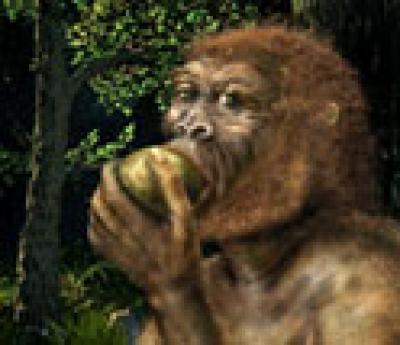
Tiny marks on the teeth of an ancient human ancestor known as the "Nutcracker Man" may upset current evolutionary understanding of early hominid diet. Using high-powered microscopes, researchers looked at rough geometric shapes on the teeth of several Nutcracker Man specimens and determined that their structure alone was not enough to predict diet.
Peter Ungar, professor of anthropology at the University of Arkansas in Fayetteville, contends the finding shows evolutionary adaptation for eating may have been based on scarcity rather than on an animal's regular diet.
"These findings totally run counter to what people have been saying for the last half a century," says Ungar. "We have to sit back and re-evaluate what we once thought."
Ungar and his colleagues, Frederick E. Grine of State University of New York at Stony Brook and Mark F. Teaford of Johns Hopkins University, Baltimore, Md., reported their findings last week in the Public Library of Science One, a peer-reviewed, international, online journal. The research was funded in part by the National Science Foundation.
The researchers examined the teeth of Paranthropus boisei, an ancient hominin that lived between 2.3 and 1.2 million years ago and is known popularly as the "Nutcracker Man" because it has the biggest, flattest cheek teeth and the thickest enamel of any known human ancestor.
"Ungar and colleagues' work on Paranthropus boisei diet is extremely important," says Joanna Lambert, physical anthropology program director at NSF. "Understanding what and how early hominins ate sheds light not only onto the feeding biology of our fossil ancestors, but also onto the very evolution of our own species."
Scientists long have believed that P. boisei fed on nuts and seeds or roots and tubers found in the savannas throughout eastern Africa because the teeth, cranium and mandible appear to be built for chewing and crunching hard objects.
But Ungar points out that the teeth only suggest "what P. boisei could eat, but not necessarily what it did eat."
Anthropologists have traditionally inferred the diet of ancient human ancestors by looking at the size and shape of the teeth and jaws. However, by using powerful microscopes to look at the patterns of wear on a tooth, scientists can get direct evidence of what the species actually ate.
Since food interacts with teeth, it leaves behind telltale signs that can be measured. Hard foods like nuts and seeds, for instance, lead to more complex tooth profiles, while tough foods like leaves lead to more parallel scratches.
Researchers compared dental microwear profiles of P. boisei to modern-day primates that eat different types of foods. P. boisei teeth were compared to those of the Old World Monkey species grey-cheeked mangabeys, and the New World Monkey species brown capuchin monkeys--both of these species consume mostly soft items but fall back on hard nuts or palm fronds.
Old World monkeys are found today in South and East Asia, the Middle East, Africa and Gibraltar at the southern tip of Spain. New World monkeys are found in tropical forest environments in southern Mexico, Central and South America.
P. boisei dental profiles also were compared to the New World mantled howling monkey and Old World silvered leaf monkey, which eat mostly leaves. Researchers also compared them to some of P. boisei's more contemporary counterparts--Australopithecus africanus, which lived between 3.3 million and 2.3 million years ago, and Paranthropus robustus, which lived between 2 million and 1.5 million years ago.
The findings showed that P. boisei teeth had light wear, suggesting that none of the individuals ate extremely hard or tough foods in the days leading up to death. The pattern was more consistent with modern-day fruit-eating animals than with most modern-day primates.
"It looks more like they were eating Jell-O," Ungar said.
This finding, while contradictory to previous speculation on the diet of P. boisei, is in line with a paradox documented in fish. Liem's Paradox states that animals may actively avoid eating the very foods they have developed adaptations for when they can find other food sources.
It appears the paradox may hold true for P. boisei and for some modern-day primates as well.
"If you give a gorilla a choice of eating fruit or a leaf, it will take the fruit every time," Ungar says. "But if you look at a gorilla's skull, its sharp teeth are adapted to consuming tough leaves. They don't eat the leaves unless they have to."
Accordingly, the finding represents a fundamental shift in the way researchers look at the diets of early human ancestors.
"For many years, the perspective has been that the very large teeth and thick dental enamel of P. boisei were adaptations to consuming very hard food types year-round," says Lambert. "Such specialization has historically been viewed as a potential cause for this fossil species' extinction. The research team demonstrated that such generalizations require careful re-thinking, and that P. boisei was a more flexible feeder than has classically been viewed."
"This challenges the fundamental assumptions of why such specializations occur in nature," Ungar says. "It shows that animals can develop an extreme degree of specialization without the specialized object becoming a preferred resource."
Source: National Science Foundation
Articles on the same topic
- New findings challenge conventional ideas on evolution of human diet, natural selectionWed, 30 Apr 2008, 18:59:04 UTC
Other sources
- New Findings Challenge Conventional Ideas On Evolution Of Human Diet, Natural Selectionfrom Science DailyWed, 30 Apr 2008, 18:55:33 UTC
- Findings Challenge Conventional Ideas on Evolution of Human Diet, Natural Selectionfrom Newswise - ScinewsWed, 30 Apr 2008, 18:52:48 UTC