


As Greenland melts
Related images
(click to enlarge)

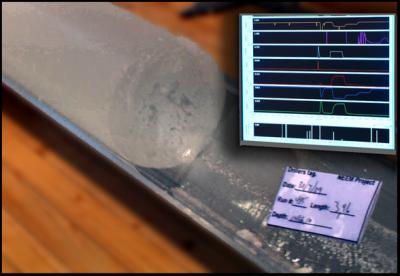
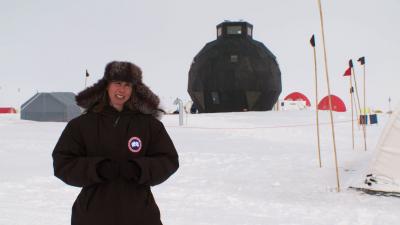
Princeton, New Jersey. October 19th, 2009 ~ Not that long ago – the blink of a geologic eye – global temperatures were so warm that ice on Greenland could have been hard to come by. Today, the largest island in the world is covered with ice 1.6 miles thick. Even so, Greenland has become a hot spot for climate scientists. Why? Because tiny bubbles trapped in the ice layers may help resolve a fundamental question about global warming: how fast and how much will ice sheets melt? Monday night on The NewsHour with Jim Lehrer (PBS), a report by Climate Central's Dr. Heidi Cullen explores efforts by an international group of scientists looking for answers. Their method: drill down through 130,000 years of accumulated ice to unlock the secrets of climate history from what geologists call the Eemian period. That was the last time the average global temperature was significantly warmer than it is today, and tiny bubbles trapped in the ice preserve key planetary conditions from that time period.
Scientists from 14 nations are participating in the North Greenland Eemian Ice drilling project, or NEEM. Dr. Cullen, Senior Research Scientist for Climate Central (climatecentral.org), a non-profit, non-advocacy group of journalists and scientists dedicated to communicating about climate change, along with a television crew from StormCenter Communications, was invited to report the story. In July she accompanied scientists to North Western Greenland where she observed ice core drilling firsthand.
"Securing a pristine ice core dating back 130,000 years will provide a snapshot of conditions on Greenland when the average global temperature was 5 to 9 degrees Fahrenheit warmer than today," says Dr. Cullen. "The Eemian provides a very realistic scenario of what we might see in the coming centuries."
Climate Central scientists calculate that in 2007, Greenland shed ice at a rate that, melted, equals the equivalent of draining San Francisco Bay – once a week – all year long. Some climate models suggest that if greenhouse emissions are not reduced, Earth's average temperature could approach Eemian era levels when today's children reach their 70's and 80's. Another key question the ice samples may help answer: how long would temperatures have to remain at those levels – or higher – to trigger a major rise in sea level?
Ice cores have been a tool for science since the Cold War, after it was discovered that air bubbles trapped in ice are science rich time capsules. Each layer of ice is a world unto itself. As Jeff Severinghaus, of Scripps Institution of Oceanography, tells Dr. Cullen, "The beautiful thing about an ice core is that it has all of these different indicators: atmospheric composition, mean ocean temperature, dust."
Dr. Cullen also reports that the Greenland project employs a new field technique – cutting a thin slab of the ice core, melting it, and conducting a millimeter-by-millimeter analysis of the drip water. When drilling ended for the 2009 summer season samples from one mile down had been retrieved, dating back over 38,000 years. Scientists hope to reach Eemian ice in the summer of 2011.
None of this is to suggest that a massive, accelerated melting of Greenland is in the offing any time soon – but as the San Francisco Bay analogy highlights –the melting in Greenland demands careful attention be paid.
Source: Climate Central
Other sources
- As Greenland meltsfrom PhysorgMon, 19 Oct 2009, 21:42:25 UTC