


New laryngoscope could make difficult intubations easier
Related images
(click to enlarge)
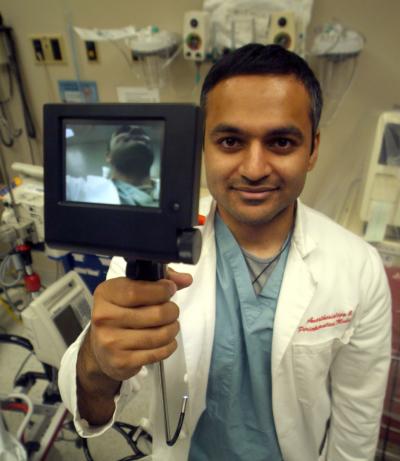
A new tool developed by a Medical College of Georgia resident and faculty member may make it easier to place assisted breathing devices under difficult circumstances. About 2 percent of patients that undergo the process, called intubation, experience complications – regardless if it's performed in an emergency situation or prior to surgery.
During normal intubation, a physician stands behind a patient's head and uses a metal scope to open the mouth and guide a flexible plastic tube into the trachea. The tube is used to maintain a patient's airway and provide a pathway for mechanical ventilation if necessary.
"In some cases, you can't see the vocal cords, which you have to go through to place the endotracheal tube, because of some obstruction," says Dr. Richard Schwartz, chair of the Department of Emergency Medicine in the MCG School of Medicine.
Some diseases, such as head and neck cancer, can make intubation harder. In other cases, anatomical variations, such as shorter necks and bucked teeth, can make tube placement more challenging, says Dr. Harsha Setty, a third-year anesthesiology resident.
Difficult intubations can be traumatic for patients and lead to problems such as cracked teeth, he says.
To make those intubations easier, Drs. Setty and Schwartz developed the Video Rigid Flexible Laryngoscope, which Dr. Setty will present to colleagues at the American Society of Anesthesiologists Oct. 17-21 in New Orleans.
The Video RIFL is composed of endotracheal tubes surrounding a rigid cylindrical body featuring an illuminated LED camera at one end and a video screen at the other. The light and camera help guide the scope down the airway. The tube is placed and released from the scope.
"Any obstructions are easier to see because of the camera and lighted tip," Dr. Schwartz says. "The flexibility of the tip also makes it easier to navigate. There is also less physical pressure on the patient, so the risk of associated trauma is reduced."
The device is the first of its kind to merge two technologies – video and articulation, he says. It's being used successfully at MCGHealth Medical Center and at other hospitals in California, North Carolina, Washington and Wisconsin.
While the device is being used primarily in operating and emergency rooms right now, the potential range of uses is broader, Dr.Schwartz says.
"It could be used in emergency rescue situations where patients are airlifted by helicopters and intubation is difficult because their heads are typically placed against a wall," he says. "In those cases, rescue workers have to intubate from the front and the camera on the RIFL makes that easier."
Dr. Setty says there are also implications for education. "I could project the camera image on a monitor to teach students how to intubate in difficult situations," he says.
Source: Medical College of Georgia
Other sources
- New laryngoscope could make difficult intubations easierfrom PhysorgThu, 15 Oct 2009, 20:07:23 UTC