


NASA's infrared satellite sees warmer cloud tops in Tropical Storm Marty
Related images
(click to enlarge)
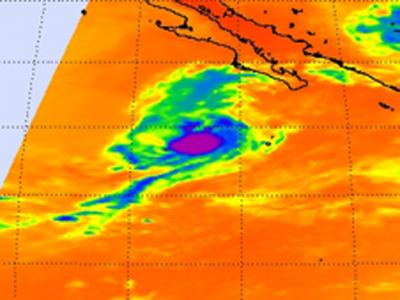
Marty is struggling to hold onto tropical storm status, and things are just going to get worse for him, as he moves into an area with stronger wind shear. Infrared satellite imagery from NASA's Aqua satellite showed that Marty's thunderstorm cloud tops are not as cold as they were earlier today, September 17, and his cloud pattern has become a little less organized. Infrared imagery from NASA's Atmospheric Infrared Sounder (AIRS) indicates Marty's cloud tops have warmed slightly, indicating lower thunderstorm heights and a weakening in the storm. High thunderstorm cloud tops indicate a strong storm. When the thunderstorm cloud heights start dropping, they become less cold, and the thunderstorms are less powerful. Cloud-top temperatures are important because they tell forecasters how high thunderstorms are, and the higher the thunderstorm, the colder the cloud tops and the more powerful the thunderstorms.
AIRS also revealed that Marty's shape has become elongated, and when a storm begins to "stretch" its circulation becomes weaker.
Forecasters at the National Hurricane Center note, "Southwesterly shear is expected to increase during the next day or two and the cyclone will be moving into a drier and more stable air mass." As a result of moving into a more hostile environment, Marty is not expected to strengthen into a hurricane and instead begin weakening.
At 11 a.m. EDT, Marty's maximum sustained winds were near 45 mph, and he was moving north-northwest near 2 mph. His center was 300 miles southwest of the southern tip of Baja California, near 19.7 north and 113.1 west. He is expected to turn toward the northwest on Friday, September 18. Minimum central pressure is near 1003 millibars.
Marty is expected to weaken to a remnant low by the weekend.
Source: NASA/Goddard Space Flight Center
Articles on the same topic
- Slow-moving Marty headed for drier air, cooler watersFri, 18 Sep 2009, 19:44:59 UTC
Other sources
- Slow-moving Marty headed for drier air, cooler watersfrom PhysorgFri, 18 Sep 2009, 21:14:50 UTC
- NASA's infrared satellite sees warmer cloud tops in Tropical Storm Martyfrom PhysorgThu, 17 Sep 2009, 22:36:24 UTC