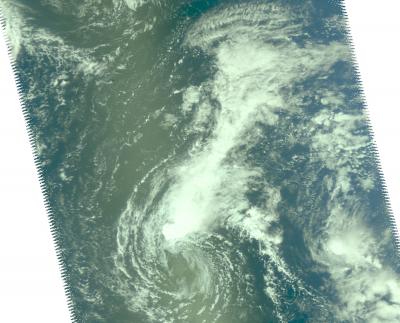
Fred fades with a satellite exclamation point
NASA's Aqua satellite flew over the remnants of Fred, September 13 and captured an infrared and visible image of the storm's clouds from the Atmospheric Infrared Sounder (AIRS) instrument. Both AIRS images showed Fred's clouds stretched from northeast to southwest and resembled a tilted exclamation mark. During the morning hours of Monday, September 14, the remnants of Fred were located about 900 miles west of the northernmost Cape Verde islands. Associated shower and thunderstorm activity remains limited...and upper-level winds are expected to remain unfavorable for re-development.
On Saturday, September 12, the National Hurricane Center (NHC) declared that Fred was indeed "dead" as a tropical cyclone. At 5 p.m. EDT that day the NHC discussion said "There has been no central convection associated with Fred since about 0000 UTC (8 p.m. EDT on Friday, September 11) and Fred is no longer classifiable using the Dvorak technique. The lack of deep convection also means that Fred is no longer a tropical cyclone and is now declared a remnant low pressure area." The NHC used data from NASA's QuikScat instrument (on the SeaWinds satellite) to determine that Fred's circulation had weakened to that point.
As of this morning, Monday, September 14, the NHC said that Fred's remnants may continue to produce intermittent shower and thunderstorm activity as it moves west-northwestward at 10 to 15 mph over the next couple of days. The Hurricane Center said that there's a small chance it may re-organize into a tropical cyclone during the next 48 hours… but it's just that: a small chance.
Source: NASA/Goddard Space Flight Center
Related
- NASA's Aqua satellite catches 2 views of super Typhoon Choi-WanThu, 17 Sep 2009, 16:56:09 EDT
- NASA's infrared satellite images reveal Ketsana's deadly western Pacific marchWed, 30 Sep 2009, 18:10:43 EDT
- NASA's infrared satellite sees warmer cloud tops in Tropical Storm MartyThu, 17 Sep 2009, 18:43:43 EDT
- NASA satellites see Ida spreading out before landfallMon, 9 Nov 2009, 17:16:13 EST
- NASA satellite sees Olaf stretch out and fizzle over northwestern mainland MexicoMon, 5 Oct 2009, 17:07:49 EDT
Other sources
- Hurricane Fred fades with a satellite exclamation pointfrom PhysorgMon, 14 Sep 2009, 12:56:10 EDT
Latest Science Newsletter
Get the latest and most popular science news articles of the week in your Inbox!Learn more about
Popular science news articles
- New study finds men and women may respond differently to danger
- Study shows new brain connections form rapidly during motor learning
- Traditional indigenous fire management techniques deployed against climate change
- Spinons -- confined like quarks
- Caltech scientists explain puzzling lake asymmetry on Titan
- Supervolcano eruption -- in Sumatra -- deforested India 73,000 years ago
- Polyphenols and polyunsaturated fatty acids boost the birth of new neurons
- First black holes may have incubated in giant, starlike cocoons, says CU-Boulder study
- First-ever blueprint of a minimal cell is more complex than expected
- Brain's fear center is equipped with a built-in suffocation sensor
- Polyphenols and polyunsaturated fatty acids boost the birth of new neurons
- Implant-based cancer vaccine is first to eliminate tumors in mice
- New device enables early detection of cancerous skin tumors -- Ben Gurion U.
- Protein from pregnancy hormone may prevent breast cancer
- First-ever blueprint of a minimal cell is more complex than expected
- New evidence that dark chocolate helps ease emotional stress
- African desert rift confirmed as new ocean in the making
- Nanoparticles used in common household items caused genetic damage in mice
- New study links vitamin D deficiency to cardiovascular disease and death
- Therapy 32 times more cost effective at increasing happiness than money