


Reveal the enemy
Related images
(click to enlarge)
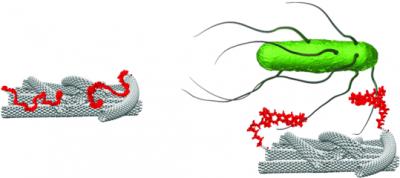
Bacterial diseases are usually detected by first enriching samples, then separating, identifying, and counting the bacteria. This type of procedure usually takes at least two days after arrival of the sample in the laboratory. Tests that work faster, in the field, and without complex sample preparation, whilst being precise and error-free, are thus high on the wish list. A Spanish research team headed by Jordi Riu and F. Xavier Rius at the University Rovira i Virgili in Tarragona has now developed a new technique to make this wish come true. With a novel biosensor, they have been able to detect extremely low concentrations of the typhus-inducing Salmonella typhi. As reported in the journal Angewandte Chemie, their new method is based on electrochemical measurements by means of carbon nanotubes equipped with aptamers as bacteria-specific binding sites. If bacteria bind to the aptamers, the researchers detect a change in electrical voltage. Aptamers are synthetic, short DNA or RNA strands that can be designed and made to bind a specific target molecule. An aptamer that specifically binds to salmonella has recently been developed. The Spanish researchers chose to use this aptamer for their biosensor. By means of additional functional groups, they securely anchored the aptamers to carbon nanotubes, which were deposited onto an electrode in an ultrathin layer.
In the absence of salmonella, the aptamers fit closely against the walls of the carbon nanotubes. If the biosensor is put into a salmonella-containing sample, the microbes stick to the aptamers like flies to flypaper. This influences the interaction between the aptamers and the nanotubes, which makes a change in the electrode voltage noticeable within seconds.
Using this biosensor, the researchers were able to detect a bacterial concentration equivalent to one salmonella bacterium in 5 mL of medium. Quantitative measurements were possible down to a concentration of about 1000 salmonella per milliliter. This biosensor is specific: it does not react to bacteria other than Salmonella typhi. "Our new technique makes the detection of micro-organisms as fast and simple as the measurement of pH value," say Riu and Rius.
Source: Wiley-Blackwell
Other sources
- Carbon nanotubes and aptamers: Vew biosensor detects extremely low bacteria concentrations quickly, easily, reliablyfrom PhysorgMon, 20 Jul 2009, 10:35:13 UTC