


A new X-ray spectroscopic tool for probing the interstellar medium
Related images
(click to enlarge)
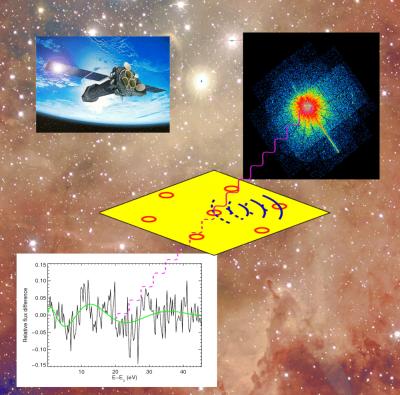
Astronomy & Astrophysics is publishing the first clear detection of signatures long sought in the spectra of X-ray astronomical sources. These signatures, the so-called EXAFS standing for "Extended X-ray Absorption Fine Structure", were observed with an X-ray spectroscopic technique that is common in materials sciences. Up to now, EXAFS studies of astronomical sources have been unsuccessful because of the weak X-ray signals received from celestial objects. Using the Reflection Grating Spectrometer (RGS) onboard the XMM-Newton satellite, Dutch astronomers C.P. de Vries and E. Costantini have obtained high-quality X-ray spectra of Scorpius X-1, one of the brightest X-ray sources in the sky, located about 2800 parsecs from the Earth. For the first time, they have found clear evidence of an EXAFS signature coming from the dust seen toward a celestial source. EXAFS is a powerful tool for studying the structure of grains in the interstellar medium (ISM). It is based on the phenomenon that X-ray photons can eject electrons from atoms inside solid particles, which in turn can be backscattered onto the emitting atom by atoms in their immediate neighborhood. This causes characteristic sinusoidal absorption features in the X-ray spectrum of a distant source that depend on the structure of the absorbing solid material.
Another, perhaps better known, technique of probing ISM dust, infrared spectroscopy, can also be used to study crystalline dust. However, EXAFS has a major advantage over infrared spectroscopy, in that it can probe the solid matter along the line-of-sight at the level of the atomic structure, even for irregular amorphous materials. Infrared spectroscopy, by comparison, provides information at the mineralogical level. As a result, using EXAFS, astronomers can obtain a very detailed sampling of the composition and atomic structure of the dust along the line-of-sight. EXAFS gives a more detailed picture of the chemical composition and atomic structure of amorphous grains than is possible with infrared spectroscopy.
Source: Astronomy & Astrophysics
Other sources
- A new X-ray spectroscopic tool for probing the interstellar mediumfrom PhysorgTue, 31 Mar 2009, 16:28:25 UTC