


Researchers develop a new technique to date forensic death based on corpse microorganisms
Related images
(click to enlarge)
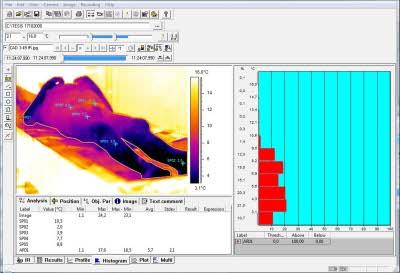
A group of scientists of the University of Granada has developed a new technique of forensic dating based on thermo-microbiology, which will allow to determine more accurately the time of a death which has not occurred under controlled natural conditions or as a consequence of a crime. This new system, of great interest in the field of criminology, establishes correspondences between the parametres of micro-organic growth on cadaverous remains and dates the time of death of such remains, as well as their relation with their temperature. The study has been carried out by Professor Isabel Fernández Corcobado and supervised by Professors Miguel Botella López, of the Laboratory of Anthropology of the UGR, and Eulogio Bedmar Gómez of the Zaidín Experimental Station (CSIC). The purpose of the project was to establish the initial methodological basis to create a protocol of general application in the field of Forensic Termography and Microbiology in order to provide new complementary tools to the existing criminalistic techniques.
Such protocol would provide a new criminalictic approach to the traditional techniques already used in the microbiological analysis of samples of all kinds. The researchers report that, in the analysis carried out with this new technique would provide information resulting of the new and fast contrast elements during the criminalistic investigation to the forensic and policial and judicial investigation teams.
To carry out this work, the authors analysed about 240 microorganic samples taken from bodies from the Institute of Legal Medicine of Granada and 352 from living donors.
Higher approach
According to Isabel Fernández, the aim of the research work was to bring criminalistic techniques closer to the analysis of the phenomenons caused during the stages of cadaverous decomposition and putrefaction, in order to reach a better approach to the estimate of the time of death.
They have used new thermographical and weather measurement tools and they have applied traditional microbiological methods with a new approach. The purpose was to make easier the analysis of the stages of cadaverous decomposition and putrefaction, connecting them with the model of growth/death of the micro-organisms, responsible for the post-mortem alterations. The aim of this work, in short, is to establish a microbiological indicator to determine the time of death.
Therefore, scientists have tried an alternative method of approach to the estimated time of death in order to reduce the present margin of error in the application of other different methods and limit to the maximum the moment of death.
The results of this research, which will be extended after its preliminary results in order to definitely validate the method, have been published in the Journal of the Biologists' Association of the Autonomous Region of Madrid.
Source: Universidad de Granada
Other sources
- New Technique Developed To Date Forensic Death Based On Corpse Microorganismsfrom Science DailyThu, 12 Mar 2009, 14:29:08 UTC