


Signal opportunities on the slopes -- with RFID
Related images
(click to enlarge)
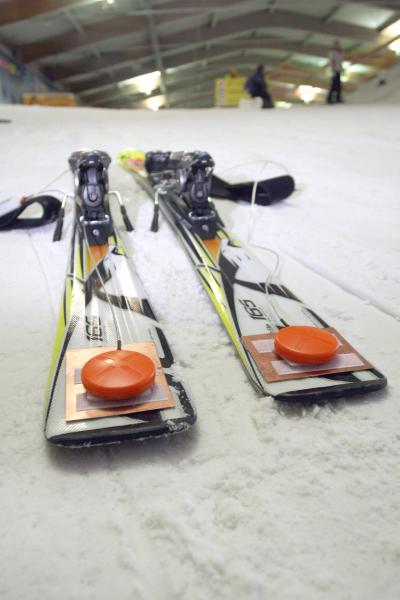
A skier gives her all, closely races past the gates in the giant slalom to the final stretch. Yet, upon reaching the bottom, the disappointment is great: Too slow once again. How come? Until now, coaches and athletes have analyzed videos to identify weaknesses in technique. "An analysis was based more on instinct than concrete measured values," explains Dr. Klaus Richter, Expert Group Manager at the Fraunhofer Institute for Factory Operation and Automation IFF in Magdeburg. In the future, transponders – radio transmitters and receivers – will support coaches in their work. They can be attached to an athlete's skis and transmit radio waves in every direction through small antennas one thousand times per second. The antennas are located to the front and the back of the skis. Receiving stations placed alongside a slope in regular intervals pick up the signals and analyze the time a signal needs to travel from the antenna to a station, thus accurately determining an antenna's position within three centimeters. The underlying technology is radio frequency identification or RFID. A computer calculates the position of the skis every millisecond and displays their exact path on a monitor. "A coach recognizes whether both skis were parallel," explains Richter, "whether the skier has drifted from her path in a curve and whether she is able to carve properly." Carving involves taking the turns entirely on the edge of one's skis.
The Austrian firm Abatec developed the system. Together with colleagues from the university in Magdeburg, the researchers at the Fraunhofer IFF are testing its systematic implementation in sports: What adhesive bonds the antennas to the skis so they do not loosen during a downhill run but can be detached when no longer needed? How can the radio signals be evaluated so a coach is able to draw conclusions about technique? Another challenge: Many skis contain metal layers of varying thicknesses, which shift a transmitter's frequency. Depending on the skis' design, the antennas transmit on another frequency and the base station no longer detects the signal. The solution: An additional metal plate under the antennas alters the signal so intensely and predictably that the slight differences between different skis are of no consequence: The antennas always transmit with the same controlled frequency. The technology performed well in initial tests in Bottrop ski hall and the system is now ready for use.
Source: Fraunhofer-Gesellschaft
Other sources
- Tiny Radio Transmitters On Skis Help Competitive Skiers Analyze Every Movefrom Science DailyTue, 10 Mar 2009, 15:41:02 UTC