


Biodiversity itself begets a species cascade, researchers say
Related images
(click to enlarge)

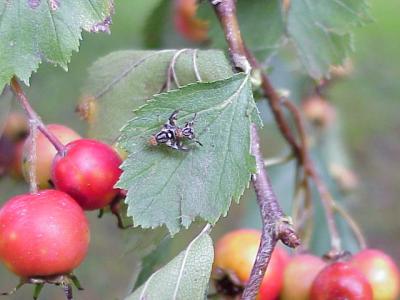
Biodiversity feeds on itself, researchers found, as evolving animals open niches for other new species. Such is the case, says a Michigan State University researcher, with a parasite found to be evolving in sequence with an emerging host insect in western Michigan apple trees. A new species of fruit fly has evolved after changing its mating behavior to favor laying eggs on apples instead of its characteristic hawthorn tree fruit host, MSU entomologist James J. Smith and colleagues reported. As those flies became genetically different from the parent hawthorn fly, so did the parasitic wasps that prey on the flies' larvae.
Apples have grown in the New World for just 250 years, demonstrating how quickly new niches can become occupied. The team's research is published as part of the cover story in the Feb. 6 issue of Science magazine, a top industry publication published by the American Association for the Advancement of Science.
The research comes to light, appropriately, as the world this week celebrates the bicentennial of the birth of Charles Darwin, the English naturalist who first described modern notions of speciation in "On the Origin of Species by Means of Natural Selection, or the Preservation of Favoured Races in the Struggle for Life."
"It makes sense that biodiversity would beget biodiversity," acknowledged Smith, who is an associate professor of biology in Lyman Briggs College, MSU's interdisciplinary science undergraduate program, and in the MSU Department of Entomology.
"What is really difficult, though, is to find hard evidence that this is what has occurred or is occurring. That is one of the real strengths of this paper. The study has large sample sizes and analyzes these organisms at a relatively high number of chromosome positions, or genetic loci," he said.
The idea that there are "speciation cascades" provides a new perspective to address some longstanding questions about the evolutionary process, he said.
"For example, why are there so many insect species? Speciation cascades provide one explanation for how a lot of species might be generated in a relatively short time period. In addition, it is not irrelevant that geographic barriers appear not to have been directly involved in species divergence in this case," Smith said.
Evolutionary divergence, he explained, tends to be associated with geographic isolation.
If fruit flies don't make an impressive example of speciation and environmental adaptation, the researchers noted, consider that more than half of all animals could be considered parasites in a broad sense, that plant-eating insects outnumber all other life forms and that one-fifth of all insects could be parasitic wasps. The conclusion, they wrote, is that "there is a world of opportunity for sequential speciation in nature."
"Clues can be found right before us as we sit on our deck chairs barbecuing and drinking pop," principal investigator Jeff Feder told Science. "All we have to do is open our eyes and we can see new life forms coming into being in that scraggly old apple tree in our backyard."
Source: Michigan State University
Other sources
- Biodiversity feeds on itselffrom Science BlogWed, 11 Feb 2009, 21:14:24 UTC
- Biodiversity feeds on itselffrom Science BlogWed, 11 Feb 2009, 15:23:07 UTC