


Research underway to give sleep apnea sufferers relief and rest
Related images
(click to enlarge)
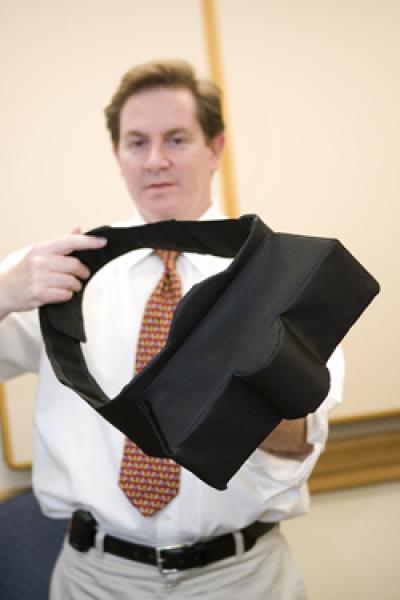
For some, a full night's rest can be anything but restful. That's because they have sleep apnea, which causes them to struggle for breath in bouts throughout the night. Six percent of the population is affected by the condition—but many don't even know they have it. "They don't make the connection between the fact that they snore loudly at night and they complain about being tired during the day," says Samuel Krachman, D.O. , professor of medicine and director of the Sleep Disorders Center at Temple University School of Medicine and Hospital. "They think that they're just tired, not getting enough sleep or just working too hard. But in reality, it's related to the sleep apnea."
Krachman is leading research on an experimental device to help patients who suffer from positional sleep apnea. Positional sleep apnea refers to patients who have episodes where they stop breathing when they're on their back, but when they are on their side, the abnormal breathing resolves. Fifty percent of patients with mild sleep apnea (those who experience anywhere from five to 15 events an hour) and 20 percent of people with moderate sleep apnea (15 to 30 events an hour) have positional sleep apnea. Krachman explains how wearing the device, called Zzoma, works to reduce those episodes.
"Zzoma is a device which is worn around the chest area like a belt, with a device on the back, which is a firm, foam material wrapped in canvas to keep them from moving on their backs. Over the last year, we've been studying its use in treating patients with mild to moderate positional sleep apnea."
The device was created by former Temple Fellow Joseph G. Crocetti. He and Krachman have worked together to treat positional sleep apnea. Their research has shown that the Zzoma device is less obtrusive and easier to use than the leading alternative, a continuous positive airway pressure machine or CPAP, a mask that blows air on a person's face to keep the airway open.
"Although CPAP is very effective, the best studies have shown it's only used correctly 50 percent of the time," says Krachman. "That leaves many diagnosed with sleep apnea but not treated."
Untreated sleep apnea can lead to a host of other medical problems. Just having sleep apnea is an independent risk factor for developing high blood pressure, coronary disease and heart failure. That's why Krachman hopes the FDA approves Zzoma to treat positional sleep apnea, to give sufferers an effective alternative to the burden of CPAP.
Source: Temple University
Other sources
- Research underway to give sleep apnea sufferers relief and restfrom PhysorgFri, 26 Sep 2008, 15:28:20 UTC