


New treatment could reduce chronic lung disease in premature babies
Related images
(click to enlarge)
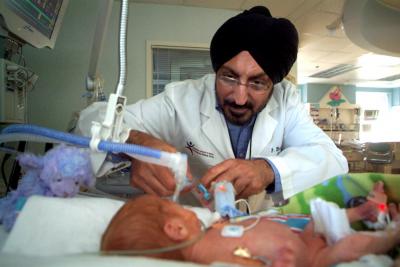
A less traumatic way of delivering surfactant, a lung lubricant that premature babies need to help them breathe, could reduce the incidence of respiratory problems they’ll have later, Medical College of Georgia physicians say. The problem is that while surfactant keeps the tiny air sacs inside the lungs from sticking together when they inflate and deflate while breathing, the delivery method causes trauma to the respiratory system and can lead to chronic lung disease, says Dr. Jatinder Bhatia, an MCG neonatologist.
“Traditionally, babies are given the surfactant through an endotracheal tube and left on the ventilator until they can be weaned off,” he says. “But that can cause trauma to the lungs in several ways – damage caused by the amount of pressure and volume used to breathe for the baby; trauma caused by the endotracheal tube; and trauma from the high concentration of oxygen.”
In a new study, Dr. Bhatia, chief of the Department of Pediatrics’ Section of Neonatology in the School of Medicine, and doctors at the University of Southern California and the University of Oklahoma are studying 60 premature babies. Thirty will receive surfactant the traditional way and another 30 will receive the substance through an endotracheal tube that is quickly removed. Those babies will then be placed on a less invasive Continuous Positive Airway Pressure device that gently pushes oxygen in through the nose.
“The idea behind this is that removing the tube as soon as you deliver the surfactant and putting them on a non-invasive nasal CPAP reduces the trauma,” Dr. Bhatia says. “The lungs of premature babies are very fragile and the ventilator can cause scarring, which results in the chronic lung disease and difficulty breathing later.”
Of the 12.5 percent of babies born prematurely in the United States each year, over 50 percent of them will develop the disease, depending on how small they are when they are born, he says.
“If a baby is born at 3 to 6 months, we could be talking about three months of recovery time spent on a ventilator and oxygen before they reach the normal gestational age (36 weeks) and can typically breathe without support,” he says. “That’s a long time to be on a ventilator.”
Doctors will reexamine the babies after one week and again at 36 weeks gestational age because chronic lung disease, which can last from one to five years, is often characterized by the need for additional oxygen after reaching 36 weeks.
As they get older, children with chronic lung disease have more asthma-like attacks, get more infections and generally have more respiratory problems because they already have damaged lungs, Dr. Bhatia says.
“There are lifetime effects as well, such as limitations of exercise,” he says. “We believe that even with the progress we’ve made with it, that we have reached a limit of the surfactant itself. The next strategies will have to be how to limit the time of being on a ventilator or positive pressure device.”
Source: Medical College of Georgia
Other sources
- New Treatment Could Reduce Chronic Lung Disease In Premature Babiesfrom Science DailyThu, 1 May 2008, 12:28:08 UTC