


New nanocrystals show potential for cheap lasers, new lighting
Related images
(click to enlarge)
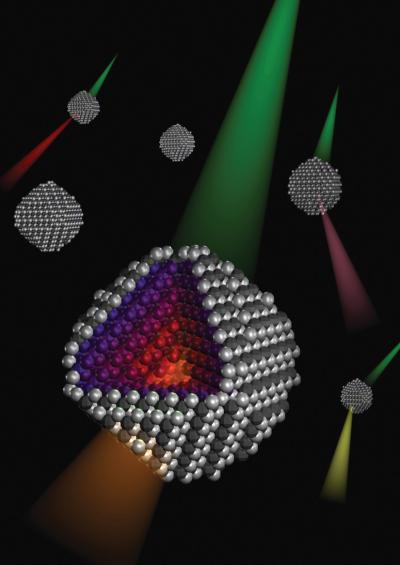
For more than a decade, scientists have been frustrated in their attempts to create continuously emitting light sources from individual molecules because of an optical quirk called "blinking," but now scientists at the University of Rochester have uncovered the basic physics behind the phenomenon, and along with researchers at the Eastman Kodak Company, created a nanocrystal that constantly emits light. The findings, detailed online in today's issue of Nature, may open the door to dramatically less expensive and more versatile lasers, brighter LED lighting, and biological markers that track how a drug interact with a cell at a level never before possible.
Many molecules, as well as crystals just a billionth of a meter in size, can absorb or radiate photons. But they also experience random periods when they absorb a photon, but instead of the photon radiating away, its energy is transformed into heat. These "dark" periods alternate with periods when the molecule can radiate normally, leading to the appearance of them turning on and off, or blinking.
"A nanocrystal that has just absorbed the energy from a photon has two choices to rid itself of the excess energy—emission of light or of heat," says Todd Krauss, professor of chemistry at the University of Rochester and lead author on the study. "If the nanocrystal emits that energy as heat, you've essentially lost that energy."
Krauss worked with engineers at Kodak and researchers at the Naval Research Laboratory and Cornell University to discover the new, non-blinking nanocrystals.
Krauss, an expert in nanocrystals, and Keith Kahen, senior principal scientist of Kodak and an expert in optoelectronic materials and devices, were exploring new types of low-cost lighting similar to organic light-emitting diodes, but which might not suffer from the short lifespans and manufacturing challenges inherent in these diodes. Kahen, with help from Megan Hahn, a postdoctoral fellow in Krauss' laboratory, synthesized nanocrystals of various compositions.
Xiaoyong Wang, another postdoctoral fellow in Krauss laboratory, inspected one of these new nanocrystals and saw no evidence of the expected blinking phenomenon. Remarkably, even after four hours of monitoring, the new nanocrystal showed no sign of a single blink—unheard of when blinks usually happen on a scale of miliseconds to minutes.
After a lengthy investigation, Krauss and Alexander Efros from the Naval Research Laboratory concluded that the reason the blinking didn't occur was due to the unusual structure of the nanocrystal. Normally, nanocrystals have a core of one semiconductor material wrapped in a protective shell of another, with a sharp boundary dividing the two. The new nanocrystal, however, has a continuous gradient from a core of cadmium and selenium to a shell of zinc and selenium. That gradient squelches the processes that prevent photons from radiating, and the result is a stream of emitted photons as steady as the stream of absorbed photons.
With blink-free nanocrystals, Krauss believes lasers and lighting could be incredibly cheap and easy to fabricate. Currently, different color laser light is created using different materials and processes, but with the new nanocrystals a single fabrication process can create any color laser. To alter the light color, an engineer needs only to alter the size of the nanocrystal, which Krauss says is a relatively simple task.
The same is true of what could one day be OLED's successor, says Krauss. Essentially, "painting" a grid of differently sized nanocrystals onto a flat surface could create computer displays as thin as paper, or a wall that lights a room in any desired color.
Source: University of Rochester
Articles on the same topic
- Discovery of non-blinking semiconductor nanocrystals advances their applicationsThu, 14 May 2009, 19:56:51 UTC