NASA satellite sees oldest-ever gamma-ray burst
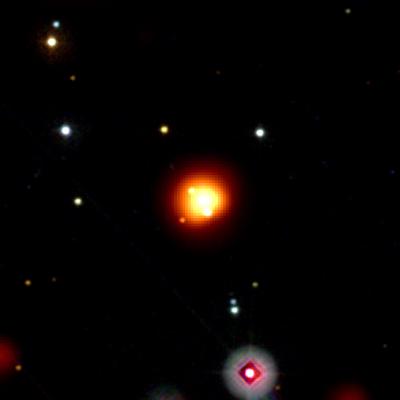
NASA's Swift satellite has found the most distant gamma-ray burst ever detected. The blast, designated GRB 080913, arose from an exploding star 12.8 billion light-years away. "This is the most amazing burst Swift has seen," said the mission's lead scientist Neil Gehrels at NASA's Goddard Space Flight Center in Greenbelt, Md. "It's coming to us from near the edge of the visible universe."
Because light moves at finite speed, looking farther into the universe means looking back in time. GRB 080913's "lookback time" reveals that the burst occurred less than 825 million years after the universe began.
The star that caused this "shot seen across the cosmos" died when the universe was less than one-seventh its present age. "This burst accompanies the death of a star from one of the universe's early generations," says Patricia Schady of the Mullard Space Science Laboratory at University College London, who is organizing Swift observations of the event.
Gamma rays from the far-off explosion triggered Swift's Burst Alert Telescope at 1:47 a.m. EDT on Sept. 13. The spacecraft established the event's location in the constellation Eridanus and quickly turned to examine the spot. Less than two minutes after the alert, Swift's X-Ray Telescope began observing the position. There, it found a fading, previously unknown X-ray source.
Astronomers on the ground followed up as well. Using a 2.2-meter telescope at the European Southern Observatory in La Silla, Chile, a group led by Jochen Greiner at the Max Planck Institute for Extraterrestrial Physics in Garching, Germany, captured the bursts fading afterglow.
The telescope's software listens for alerts from Swift and automatically slewed to the burst position. Then, the team's Gamma-Ray Burst Optical/Near-Infrared Detector, or GROND, simultaneously captured the waning light in seven wavelengths. "Our first exposure began just one minute after the X-Ray Telescope started observing," Greiner says.
In certain colors, the brightness of a distant object shows a characteristic drop caused by intervening gas clouds. The farther away the object is, the longer the wavelength where this fade-out begins. GROND exploits this effect and gives astronomers a quick estimate of an explosion's shift toward the less energetic red end of the electromagnetic spectrum, or "redshift," which suggests its record-setting distance.
An hour and a half later, as part of Greiner's research, the Very Large Telescope at Paranal, Chile, targeted the afterglow. Analysis of the spectrum with Johan Fynbo of the University of Copenhagen established the blasts redshift at 6.7 -- among the most distant objects known.
Gamma-ray bursts are the universe's most luminous explosions. Most occur when massive stars run out of nuclear fuel. As their cores collapse into a black hole or neutron star, gas jets -- driven by processes not fully understood -- punch through the star and blast into space. There, they strike gas previously shed by the star and heat it, which generates bright afterglows.
The previous record holder was a burst with a redshift of 6.29, which placed it 70 million light-years closer than GRB 080913.
Swift, launched in November 2004, has had a banner year. In March, the satellite detected the brightest gamma-ray burst, which was visible to the human eye despite occurring billions of light-years away. And in January, the spacecraft's instruments caught the first X-rays from a new supernova days before optical astronomers saw the exploding star.
Source: NASA/Goddard Space Flight Center
Related
- Keck study sheds new light on 'dark' gamma-ray burstsMon, 8 Jun 2009, 12:50:02 EDT
- NASA's Swift looks to comets for a cool viewWed, 3 Dec 2008, 16:25:02 EST
- NASA's Swift, Fermi probe fireworks from a flaring gamma-ray starTue, 10 Feb 2009, 12:37:36 EST
- Swift Satellite records early phase of gamma ray burstMon, 2 Mar 2009, 12:33:08 EST
- Fog lifted on 'dark' gamma-ray bursts, mysterious counterparts to bursts with an afterglowMon, 8 Jun 2009, 12:50:09 EDT
Articles on the same topic
- 'Naked-eye' gamma-ray burst was aimed squarely at EarthThu, 11 Sep 2008, 11:17:08 EDT
- The double firing burstWed, 10 Sep 2008, 13:29:10 EDT
Other sources
- NASA Swift satellite sees oldest-ever gamma-ray burstfrom Science CentricTue, 23 Sep 2008, 11:08:36 EDT
- GRB 080913 - Brightest Gamma Ray Burst To-Date Existed Before The Milky Wayfrom Scientific BloggingMon, 22 Sep 2008, 17:56:08 EDT
- Swift Catches Farthest Ever Gamma-Ray Burstfrom PhysorgMon, 22 Sep 2008, 16:56:13 EDT
- Swift sees farthest gamma-ray burstfrom UPIMon, 22 Sep 2008, 11:42:27 EDT
- Observatory detects record burstfrom BBC News: Science & NatureFri, 19 Sep 2008, 20:07:13 EDT
- NASA's Swift Catches Farthest Ever Gamma-Ray Burstfrom Science DailyFri, 19 Sep 2008, 19:35:15 EDT
- SPACE PHOTOS THIS WEEK: Dark Matter, Gamma Ray Burstfrom National GeographicWed, 17 Sep 2008, 12:35:18 EDT
- Brightest Stellar Explosion Heralds New Type Of Long-distance Astronomyfrom Science DailyMon, 15 Sep 2008, 11:56:52 EDT
- That flash you saw? Just a star blastfrom LA Times - ScienceMon, 15 Sep 2008, 7:49:19 EDT
- Brightest Stellar Explosion Heralds New Type Of Long-distance Astronomyfrom Science DailySun, 14 Sep 2008, 22:21:12 EDT
- That flash you saw? Just a star blastfrom LA Times - ScienceSat, 13 Sep 2008, 11:56:09 EDT
- Brightest Gamma-Ray Burst Packed a One-Two Punchfrom Scientific AmericanFri, 12 Sep 2008, 15:35:51 EDT
- 'Naked-eye' gamma-ray burst was aimed squarely at Earthfrom Science BlogThu, 11 Sep 2008, 12:42:08 EDT
- Huge star explosion aimed gamma ray burst at Earthfrom Reuters:ScienceThu, 11 Sep 2008, 10:22:45 EDT
- Brightest Gamma-Ray Burst Packed a One-Two Punchfrom Scientific AmericanThu, 11 Sep 2008, 9:35:06 EDT
- Brightest Gamma-ray Burst Provides Wealth Of Information On How Stars Explodefrom Science DailyWed, 10 Sep 2008, 22:28:24 EDT
- A Bright Light Shining Upon Usfrom Science NOWWed, 10 Sep 2008, 17:42:06 EDT
- NASA: Gamma-ray burst was aimed at Earthfrom UPIWed, 10 Sep 2008, 16:14:09 EDT
- Naked-Eye Gamma-ray Burst Aimed Directly at Earthfrom Science @ NASAWed, 10 Sep 2008, 16:00:16 EDT
- Huge star explosion aimed gamma ray burst at Earthfrom Reuters:ScienceWed, 10 Sep 2008, 16:00:15 EDT
- GRB 080319B - So Bright Your Eyes Could See It From Half A Universe Awayfrom Scientific BloggingWed, 10 Sep 2008, 14:07:21 EDT
- 'Naked Eye' Gamma Ray Burst Was Aimed Squarely At Earthfrom PhysorgWed, 10 Sep 2008, 13:21:11 EDT
- 'Naked eye' gamma-ray burst was aimed almost directly at the Earthfrom Science CentricWed, 10 Sep 2008, 13:14:05 EDT
Latest Science Newsletter
Get the latest and most popular science news articles of the week in your Inbox!Learn more about
Popular science news articles
- NIST demonstrates 'universal' programmable quantum processor
- Transcendental Meditation helped heart disease patients lower cardiac disease risks by 50 percent
- Nanoparticles used in common household items caused genetic damage in mice
- Boehringer Ingelheim announces Phase III data of flibanserin in pre-menopausal women with HSDD
- Heart disease found in Egyptian mummies
- African desert rift confirmed as new ocean in the making
- 1 shot of gene therapy and children with congenital blindness can now see
- Scientists discover influenza's Achilles heel: Antioxidants
- Cleanliness is next to godliness: New research shows clean smells promote moral behavior
- New evidence that dark chocolate helps ease emotional stress
No popular news yet
- Nanoparticles used in common household items caused genetic damage in mice
- Treatment with folic acid, vitamin B12 associated with increased risk of cancer, death
- New study links vitamin D deficiency to cardiovascular disease and death
- Continuous chest compression-CPR improved cardiac arrest survival in Arizona
- Therapy 32 times more cost effective at increasing happiness than money