


Scientists may have solved an ecological riddle
Related images
(click to enlarge)
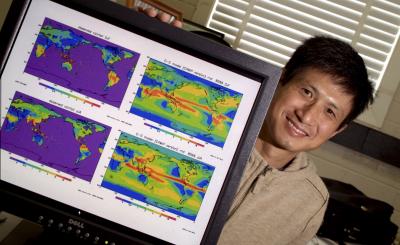
In a paper published this week in Nature, the authors – including Dr Ying Ping Wang from The Centre for Australian Weather and Climate Research – say that nitrogen fixation has long been recognised as an important process in controlling responses of many ecosystems – particularly boreal and temperate forests – to global environmental change. "However, there have been significant discrepancies between real-world observations and the theories used to predict nitrogen fixation patterns across major sectors of the land biosphere," Dr Wang says.
"We believe our theory provides a unifying framework for nitrogen fixation which can explain the different levels of fixation observed in a wide range of climatically and geographically-defined terrestrial ecosystems right around the world," he says.
The team found that nitrogen-fixing species in phosphorous-limited tropical savannas and lowland tropical forests enjoyed a clear advantage over nitrogen-fixing species found in mature forests at high latitudes, where modern-day temperatures appeared to have constrained their numbers and nitrogen-fixing abilities.
The team developed two new hypotheses for understanding the distribution of nitrogen fixing plants across global ecosystems.
The first is that temperature constrains the distribution of nitrogen fixation, contributing to the lack of nitrogen-fixing trees in mature forests at high latitudes.
The second – that nitrogen-fixing plants hold an advantage in terms of their ability to acquire additional phosphorus – provides an explanation for the persistence of nitrogen-fixing plants in mature lowland tropical forest and savannas.
"Working on the basis of these two hypotheses we have produced a new model, which should help scientists to better predict the effect of climate change on different ecosystems and the interactions between terrestrial biosphere and climate change at decadal-to-century time scales," Dr Wang says.
Source: CSIRO Australia
Other sources
- Why some plants prefer tropicsfrom Science AlertSun, 22 Jun 2008, 13:07:12 UTC