


Scientists find genetic cause of multiple sclerosis
Related images
(click to enlarge)

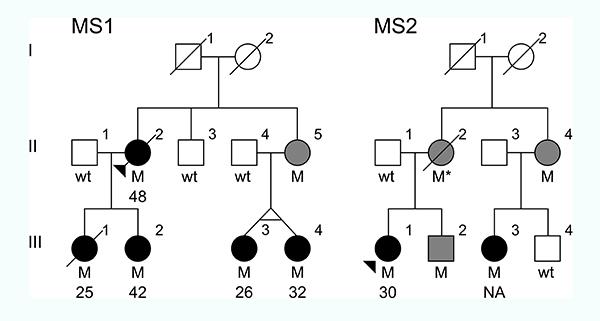
Scientists at the University of British Columbia and Vancouver Coastal Health have proven that multiple sclerosis (MS) can be caused by a single genetic mutation - a rare alteration in DNA that makes it very likely a person will develop the more devastating form of the neurological disease. The mutation was found in two Canadian families that had several members diagnosed with a rapidly progressive type of MS, in which a person's symptoms steadily worsen and for which there is no effective treatment.
The discovery of this mutation should erase doubts that at least some forms of MS are inherited. The prevailing view has been that a combination of many genetic variations cause a slight increase in susceptibility. In the two families described in this study, two-thirds of the people with the mutation developed the disease.
"This mutation puts these people at the edge of a cliff, but something still has to give them the push to set the disease process in motion," said senior author Carles Vilarino-Guell, an assistant professor of medical genetics and a member of the Djavad Mowafaghian Centre for Brain Health.
Although only one in 1,000 MS patients appears to have this mutation, its discovery helps reveal the biological pathway that leads to the rapidly progressive form of the disease, accounting for about 15 per cent of people with MS. The discovery could also provide insight into the more common, fluctuating form of MS, known as "relapsing-remitting," because in most cases, that disease gradually becomes progressive.
The findings, published today in the journal Neuron, could help in the search for therapies that act upon the gene itself or counteract the mutation's disease-causing effects. More immediately, screening for the mutation in high-risk individuals could enable earlier diagnosis and treatment before symptoms appear.
"If you have this gene, chances are you will develop MS and rapidly deteriorate," said co-author Dr. Anthony Traboulsee, the MS Society of Canada Research Chair at UBC and Director of Vancouver Coastal Health's MS and Neuromyelitis Optica Clinic. "This could give us a critical early window of opportunity to throw everything at the disease, to try to stop it or slow it. Until now, we didn't have much basis for doing that."
Source: University of British Columbia
Articles on the same topic
- First gene mutation explaining development of multiple sclerosis foundWed, 1 Jun 2016, 18:28:18 UTC
Other sources
- Rare Gene Mutation Linked with High MS Riskfrom Live ScienceWed, 1 Jun 2016, 18:21:06 UTC
- First gene mutation explaining development of multiple sclerosisfrom Science DailyWed, 1 Jun 2016, 18:20:56 UTC
- ANKRD55: New gene involved in Multiple Sclerosis discoveredfrom Science DailyMon, 30 May 2016, 15:11:09 UTC