


Not just another brick in the (plant cell) wall
Related images
(click to enlarge)
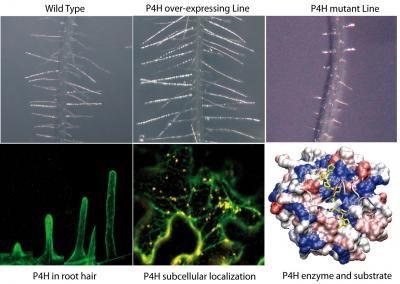
In a new study revealing key steps for controlling plant growth, Australian researchers have shown how the assembly of components of the plant cell wall regulates growth of root hairs. Root hairs are important structures that allow plants to absorb essential nutrients and water from the soil. The research will assist in contributing to the sustainability of Australia's plant -based industries such as, agriculture, horticulture and forestry. Co-author Professor Tony Bacic from the ARC Centre of Excellence in Plant Cell Walls, School of Botany and the Bio21 Institute, at the University of Melbourne, said plant cell walls (plant biomass) represent the world's largest renewable resource.
"Plant sciences have become a major new driver of international research due to their central role as renewable sources of transport fuels, as functional foods to improve human health, and as a source of raw materials for industrial processes," he said.
The study has been published in the current issue of the international journal Science.
Most plant roots are covered in fine root hairs which seek out nutrients in the soil and increase the roots' surface area, allowing more water and nutrients to be absorbed.
"The root hair is therefore very important and this work could have applications for plants growing in dry and nutrient-deficient soils as they need to optimise their nutrient and water uptake," Professor Bacic said.
The root hair is a single tubular cell which grows out from the plant's root surface and is surrounded by a wall rich in complex carbohydrates and glycoproteins. This wall surrounds the cell to strengthen it, like a building scaffold.
So to study root hair growth, an international multidisciplinary team of researchers from Argentina, Australia, the United States, Denmark and Brazil targeted genes involved in the production of wall glycoproteins in the model laboratory plant Arabidopsis.
The team identified three groups of genes required for the assembly of the cell wall scaffold glycoprotein, called extensin. When the genes were prevented from functioning, the root hairs were stunted. Without these scaffold glycoproteins and their complete sugar decorations they don't form their correct molecular shape to enable root hair growth. What controls the expression of these genes is the next important question to be addressed.
"This study enhances our fundamental understanding of the growth of plants, our major renewable resource, and would not have been possible without our international collaboration through the ARC Centre of Excellence in Plant Cell Walls," said Professor Bacic.
Source: University of Melbourne
Articles on the same topic
- The sweet growth of plant cellsFri, 17 Jun 2011, 14:05:21 UTC
Other sources
- The sweet growth of plant cellsfrom Science DailyFri, 17 Jun 2011, 17:30:29 UTC
- Not just another brick in the (plant cell) wallfrom Science DailyFri, 17 Jun 2011, 17:30:28 UTC
- Not just another brick in the (plant cell) wallfrom PhysorgFri, 17 Jun 2011, 14:00:49 UTC
- The sweet growth of plant cellsfrom PhysorgThu, 16 Jun 2011, 19:30:50 UTC