


Research team identifies receptor for Ebola virus
Related images
(click to enlarge)
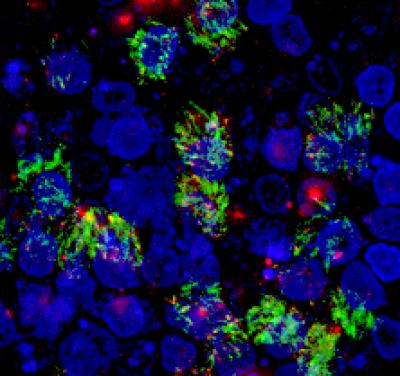
A team of researchers has identified a cellular protein that acts as a receptor for Ebola virus and Marburg virus. Furthermore, the team showed that an antibody, which binds to the receptor protein, is able to block infection by both viruses. "This is the first receptor identified for Ebola and Marburg viruses," said Wendy Maury, Ph.D., associate professor of microbiology at the University of Iowa Roy J. and Lucille A. Carver College of Medicine and senior study author. "That's important because if you can identify and understand the first step in infection - how the virus enters cells - then perhaps you can prevent the infection by nipping it in the bud."
Ebola and Marburg viruses cause hemorrhagic fever in humans and other primates. For some strains, infection can lead to death in 50 to 90 percent of cases, and there is no cure or effective treatment. The findings are published online the week of May 2 in the Proceedings of the National Academy of Sciences Early Edition.
Maury led a multidisciplinary team that included colleagues from four UI departments as well as collaborators at the National Institute of Dental and Craniofacial Research (NIDCR) in Bethesda, Md., University of Texas Medical Branch in Galveston, Texas, and Biogen Idec, in Cambridge, Mass.
The researchers used a new bioinformatics-based approach, developed by John Chiorini at NIDCR, to identify a protein called TIM-1 as a receptor for Ebola and Marburg viruses. Subsequent experiments proved that both Ebola and Marburg viruses use TIM-1 is a receptor for infecting cells.
The study also showed that TIM-1 protein is widely expressed on epithelial cells that line various tissues in the body including mucosal surfaces of the airways and in the eyes.
Maury noted that these locations are consistent with some of the ways the Ebola virus is thought to be transmitted -- inhalation of aerosolized droplets and hand-to-eye contact.
A further collaboration with Paul Rennert, Ph.D., at Biogen Idec, a biotech company based in Cambridge, Mass., provided the team with antibodies targeted to TIM-1 and the team found that one of these antibodies, ARD5, very effectively blocks Ebola and Marburg virus entry into cells.
Finally, work performed by Robert Davey, Ph.D., in a BSL-4 lab (the highest level of biocontainment) at University of Texas Medical Branch verified that the ARD5 antibody blocks infection by infectious Zaire Ebola Virus in cells that express the TIM-1 protein.
The results suggest that being able to block Ebola's entry into epithelial cells, perhaps with a human-compatible version of the ARD5 antibody, might provide a way to prevent initial infection and potentially limit the spread of the disease during an outbreak.
Importantly, the study found that TIM-1 protein is not expressed on all the cell types that are infected by Ebola and Marburg.
"It's clear that there are other receptors for Ebola because while TIM-1 is found on a number of epithelial cells in the body, it is not found on some important cell types that are infected by Ebola," Maury said. "Ultimately, epithelial cells are not as important a target for the virus as some other cell types, but they may be the first entry point for Ebola, so they may provide a conduit that allows Ebola access to those other cells within the body."
Source: University of Iowa Health Care
Other sources
- Research team identifies receptor for Ebola virusfrom Biology News NetTue, 3 May 2011, 0:30:30 UTC
- Receptor for Ebola virus identifiedfrom Science DailyMon, 2 May 2011, 20:31:12 UTC
- Research team identifies receptor for Ebola virusfrom PhysorgMon, 2 May 2011, 19:20:14 UTC