


Icebergs in the Antarctic play important role in carbon cycle
Related images
(click to enlarge)

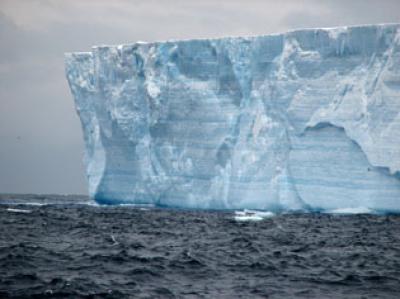
Icebergs cool and dilute the ocean water they pass through and also affect the distribution carbon-dioxide-absorbing phytoplankton in the Southern Ocean, according to a team of researchers from UC San Diego and the University of San Diego. The effects are likely to influence the growth of phytoplankton in the Atlantic sector of the Southern Ocean and especially in an area known as "Iceberg Alley" east of the Antarctic Peninsula.
Enhanced phytoplankton growth would increase the rate at which carbon dioxide is removed from the ocean, an important process in the carbon cycle, said the leaders of the National Science Foundation (NSF)-funded study.
The results appear in the journal Deep-Sea Research II in a paper titled "Cooling, dilution and mixing of ocean water by free-drifting icebergs in the Weddell Sea." The main results from this paper were also highlighted in Nature Geoscience's March issue.
"Iceberg transport and melting have a prominent role in the distribution of phytoplankton in the Weddell Sea," said paper lead author John J. Helly, who holds joint appointments at the San Diego Supercomputer Center and Scripps Institution of Oceanography at UCSD. "These results demonstrate the importance of a multi-disciplinary scientific team in developing a meaningful picture of nature across multiple scales of measurement and the unique contributions of ship-based field research."
"The results demonstrate that icebergs influence oceanic surface waters and mixing to greater depths than previously realized," added paper co-author Ronald S. Kaufmann, Associate Professor of Marine Science and Environmental Studies at the University of San Diego.
The findings document a persistent change in physical and biological characteristics of surface waters after the transit of an iceberg. The change in surface water properties such as salinity lasted at least ten days, far longer than had been expected.
Sampling was conducted by a surface-mapping method used to survey the area around an iceberg more than 32 kilometers (20 miles) in length. The team surveyed the same area again ten days later, after the iceberg had drifted away. After ten days, the scientists observed increased concentrations of chlorophyll a and reduced concentrations of carbon dioxide compared to nearby areas without icebergs.
"We were quite surprised to find the persistence of the iceberg effects over many days," said Helly, director of the Laboratory for Environmental and Earth Sciences at SDSC.
The new results demonstrate that icebergs provide a connection between the geophysical and biological domains that directly affects the carbon cycle in the Southern Ocean. This research significantly extends previous research results conducted in the same environment and reveals the dynamic properties of icebergs and their effects on the ocean in unexpected ways.
"These findings confirm that icebergs are a dynamic and significant component of polar ecosystems," said Roberta L. Marinelli, director of the NSF's Antarctic Organisms and Ecosystems Program.
Source: University of California - San Diego
Articles on the same topic
- Antarctic icebergs play a previously unknown role in global carbon cycle, climateFri, 25 Mar 2011, 20:05:38 UTC
Other sources
- Icebergs in the Antarctic Play Important Role in Carbon Cyclefrom Newswise - ScinewsMon, 28 Mar 2011, 20:20:07 UTC
- Icebergs Play a Previously Unknown Role in Global Carbon Cycle, Climatefrom Science BlogSat, 26 Mar 2011, 14:30:12 UTC
- Antarctic icebergs play a previously unknown role in global carbon cycle, climatefrom Science DailyFri, 25 Mar 2011, 21:30:22 UTC
- Antarctic icebergs play a previously unknown role in global carbon cycle, climatefrom PhysorgFri, 25 Mar 2011, 19:00:37 UTC