


Threshold sea surface temperature for hurricanes and tropical thunderstorms is rising
Related images
(click to enlarge)
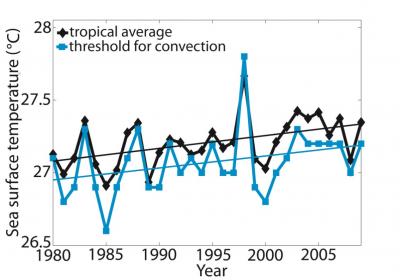

Scientists have long known that atmospheric convection in the form of hurricanes and tropical ocean thunderstorms tends to occur when sea surface temperature rises above a threshold. The critical question is, how do rising ocean temperatures with global warming affect this threshold? If the threshold does not rise, it could mean more frequent hurricanes. According to a new study by researchers at the International Pacific Research Center (IPRC) of the University of Hawaii at Manoa (UHM), this threshold sea surface temperature for convection is rising under global warming at the same rate as that of the tropical oceans. Their paper appears in the Advance Online Publications of Nature Geoscience.
In order to detect the annual changes in the threshold sea surface temperature, Nat Johnson, a postdoctoral fellow at IPRC, and Shang-Ping Xie, a professor of meteorology at IPRC and UHM, analyzed satellite estimates of tropical ocean rainfall spanning 30 years. They find that changes in the threshold temperature for convection closely follow the changes in average tropical sea surface temperature, which have both been rising approximately 0.1°C per decade.
"The correspondence between the two time series is rather remarkable," says lead author Johnson. "The convective threshold and average sea surface temperatures are so closely linked because of their relation with temperatures in the atmosphere extending several miles above the surface."
The change in tropical upper atmospheric temperatures has been a controversial topic in recent years because of discrepancies between reported temperature trends from instruments and the expected trends under global warming according to global climate models. The measurements from instruments have shown less warming than expected in the upper atmosphere. The findings of Johnson and Xie, however, provide strong support that the tropical atmosphere is warming at a rate that is consistent with climate model simulations.
"This study is an exciting example of how applying our knowledge of physical processes in the tropical atmosphere can give us important information when direct measurements may have failed us," Johnson notes.
The study notes further that global climate models project that the sea surface temperature threshold for convection will continue to rise in tandem with the tropical average sea surface temperature. If true, hurricanes and other forms of tropical convection will require warmer ocean surfaces for initiation over the next century.
Source: University of Hawaii at Manoa
Other sources
- Threshold sea surface temperature for hurricanes and tropical thunderstorms is risingfrom PhysorgMon, 8 Nov 2010, 14:30:22 UTC