


Link between iron overload and macular degeneration under study
Related images
(click to enlarge)
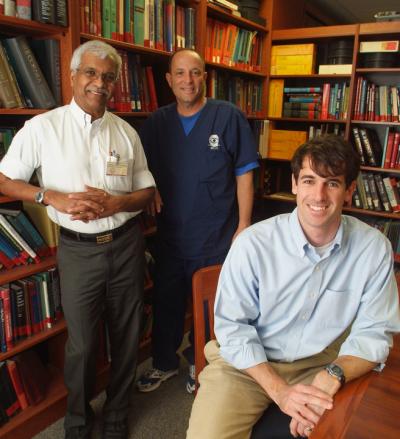
The most common – and under-diagnosed – genetic disease in humans just may be a cause of the worst form of macular degeneration, Medical College of Georgia researchers report. They are pursuing a link between hemochromatosis, which results in iron overload, and the wet form of macular degeneration, the leading cause of blindness in people 60 and older. They suspect that too much iron, known to wreak cumulative havoc on the body's organs, hastens normal aging of the eyes.
If they are correct, avoiding the most severe consequences of a disease that robs the central vision could be as simple as donating blood a couple times annually to reduce iron levels, said Dr. Vadivel Ganapathy, chairman of the MCG School of Medicine Department of Biochemistry and Molecular Biology.
A $1.5 million grant from the National Eye Institute is enabling the MCG scientists to define the impact of hemochromatosis on the eye's form and function. Support from MCG's Vision Discovery Institute is enabling screening for its causative genetic mutation in the blood of healthy individuals and those with macular degeneration.
"If this is a predisposing risk for macular degeneration, we have a very useful tool for screening patients," said Dr. Julian Nussbaum, a retinal specialist who chairs the School of Medicine's Department of Ophthalmology and co-directs MCG's Vision Discovery Institute. "We can give patients information right off the bat that may help them."
While linking iron overload to eye disease may seem odd, they have in common the result of too much of a good thing. The eyes need light to see and the body needs iron to deliver oxygen but the price of both is increased oxidative stress, Ganapathy said. "You need oxygen and you need iron to make this bad molecule," he said of oxygen radicals that can destroy tissue down to the DNA.
Light alone takes a slow toll on the retina, which converts it into electrical impulses sent to the brain via the optic nerve. This is despite multiple built-in safeguards such as filters in the cornea and lens that protect against the most harmful rays, like ultraviolet light, and a yellow pigment that provides extra protection for the most central point of vision. Retinal pigmented epithelial cells, which nourish sight-enabling cells in the retina, help gobble up and dump any resulting tissue trash into the circulation for elimination. Leftovers show up as fatty, yellow deposits called drusen.
Everyone experiences some age-related vision changes and accumulation of harmless levels of drusen, Nussbaum said.
But when byproducts start accumulating under the retinal pigment epithelium, the risk increases for the wet form of macular degeneration in which fragile new blood vessels grow underneath the retina, leak and cloud vision. The question is why some people's condition worsens.
"We see it in one patient and it may stay that way for 20 years. We see it in another patient and within five years their vision has functionally started to decrease," said Dr. Emory Patterson, an MCG School of Medicine graduate completing his ophthalmology residency at MCG who is helping with the clinical study.
Ganapathy first determined that the eye had the means to tightly regulate iron levels. Most organs don't have their own system rather the small intestine regulates absorption of the iron consumed in foods like beans and tofu.
But Ganapathy found the same genetic mutation that causes hemochromatosis in a back layer of the retina, which comes in contact with the blood. A mutation in this HFE gene impairs a protein that regulates iron absorption. The finding in the mouse eye and human retinal pigmented epithelial cells was published in 2004 in Investigative Ophthalmology and Visual Science.
His lab now has animal models for hemochromatosis as well as juvenile hemochromatosis, which is caused by a different genetic defect and produces much earlier symptoms.
In the retina of the models, he's finding increased expression of vascular endothelial growth factors, or VEGF, that enable new blood vessel growth. This growth is the hallmark of the wet form of macular degeneration. In fact, anti-VEGF therapies are the most potent treatments available.
"I tell patients that caught early, they have a 92 percent chance of stabilizing their vision with anti-VEGF therapy but they only have about a 38 percent chance of improving their vision," Nussbaum said. "But at least we can treat it. I also remind them there is not a cure. It's similar to cancer therapy: we can put them into remission but we don't know if it will come back."
Most people absorb about 10 percent of the iron they consume. Symptoms such as joint pain, fatigue, lack of energy, abdominal pain, loss of sex drive and heart problems indicate excess absorption although many with the condition have no symptoms when diagnosed.
Source: Medical College of Georgia
Other sources
- Link between iron overload and macular degeneration under studyfrom Science DailyThu, 24 Jun 2010, 16:33:35 UTC
- Link between iron overload and macular degeneration under studyfrom PhysorgThu, 24 Jun 2010, 15:32:20 UTC
- Link between iron overload and macular degeneration under studyfrom Science BlogThu, 24 Jun 2010, 15:07:43 UTC