


Scientists discover largest orb-weaving spider
Related images
(click to enlarge)
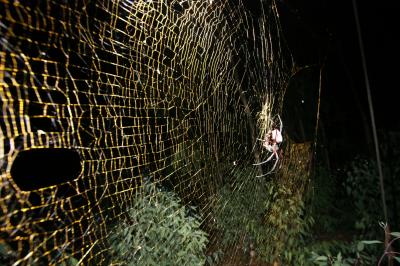
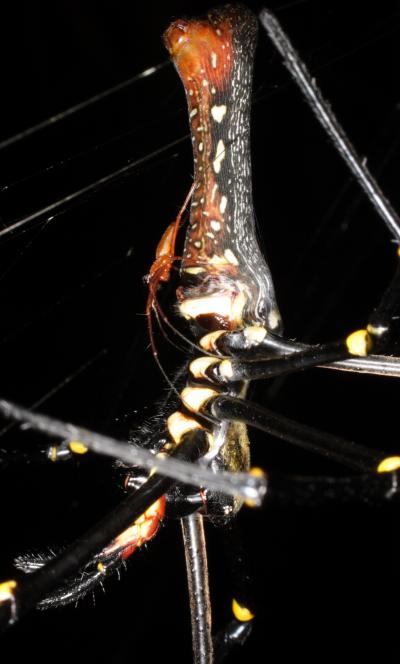
Researchers from the United States and Slovenia have discovered a new, giant Nephila species (golden orb weaver spider) from Africa and Madagascar and have published their findings in the Oct. 21 issue of the journal PLoS ONE. Matjaž Kuntner, chair of the Institute of Biology of the Slovenian Academy of Sciences and Arts and a Smithsonian research associate, along with Jonathan Coddington, senior scientist and curator of arachnids and myriapods in the Department of Entomology at the Smithsonian's National Museum of Natural History, also reconstructed size evolution in the family Nephilidae to show that this new species, on average, is the largest orb weaver known. Only the females are giants with a body length of 1.5 inches (3.8 centimeters) and a leg span of 4 - 5 inches (10 - 12 centimeters); the males are tiny by comparison. More than 41,000 spider species are known to science with about 400 - 500 new species added each year. But for some well-known groups, such as the giant golden orb weavers, the last valid described species dates back to the 19th century.
Nephila spiders are renowned for being the largest web-spinning spiders. They make the largest orb webs, which often exceed 3 feet (1 meter) in diameter. They are also model organisms for the study of extreme sexual size dimorphism and sexual biology.
Giant golden orb weavers are common throughout the tropics and subtropics. Thousands of Nephila specimens that have been collected are in natural history museums. Past taxonomists collectively recognized 150 distinct Nephila species, but in his doctoral thesis, Kuntner recognized only 15 species as valid. Linnaeus described the first Nephila species in 1767, and Karsch described the last genuinely new Nephila in 1879. All more recent descriptions turned out to be synonyms.
"It was surprising to find a giant female Nephila from South Africa in the collection of the Plant Protection Research Institute in Pretoria, South Africa, that did not match any described species," said Kuntner, who first examined the specimen in 2000.
Kuntner, Coddington and colleagues launched several expeditions to South Africa specifically to find this species, but all were unsuccessful, suggesting that perhaps the Nephila specimen, first collected in 1978, was a hybrid or perhaps an extinct species. In 2003 a second specimen from Madagascar (in the Naturhistorisches Museum Wien in Vienna, Austria) suggested it was not a hybrid. No additional specimens turned up among more than 2,500 samples from 37 museums. The species seemed extinct. Then a few years ago a South African colleague found a male and two females in Tembe Elephant Park, and it became clear that the specimens were indeed a valid new species.
In the PLoS ONE paper, Kuntner and Coddington described N. komaci as a new species, now the largest web-spinning species known, and placed it on the evolutionary tree of Nephila. They then modeled evolution to test if natural selection had affected body size. They found strong evidence that it had, but only in females. Nephila females consistently through time increased in size and, mainly in Africa, a group of giant spiders evolved. Nephila males, in contrast, did not grow larger, but instead remained about five times smaller than their mates. Although males look like "miniatures" next to their mates, the males are actually normal-sized; the females are giants.
The new species was named after Kuntner's best friend Andrej Komac, who died in an accident at the time of these discoveries. "My friend, himself a scientist, encouraged me to tackle this PhD, but did not live to see the discoveries made," said Kuntner. "He was a big inspiration, and a great friend, thus it was logical to name this new species to his memory."
Kuntner and Coddington urge the public to find new populations of N. komaci in Africa or Madagascar, both to facilitate more research on the group, but also because the species seems to be extremely rare. "We fear the species might be endangered, as its only definite habitat is a sand forest in Tembe Elephant Park in KwaZulu-Natal," said Coddington. "Our data suggest that the species is not abundant, its range is restricted and all known localities lie within two endangered biodiversity hotspots: Maputaland and Madagascar."
Source: Smithsonian
Other sources
- Largest Web-Spinning Spider Foundfrom National GeographicWed, 21 Oct 2009, 19:56:08 UTC
- Largest web-spinning spider discoveredfrom MSNBC: ScienceWed, 21 Oct 2009, 17:07:10 UTC
- Scientists discover largest orb-weaving spiderfrom PhysorgWed, 21 Oct 2009, 10:49:07 UTC
- Scientists Discover Largest Orb-weaving Spiderfrom Science DailyWed, 21 Oct 2009, 6:14:38 UTC
- 'Giant' orb web spider discoveredfrom BBC News: Science & NatureWed, 21 Oct 2009, 2:28:06 UTC